India Secures Long-Term Uranium Supply Deal with Australia
Recently, India secured a long-term uranium supply agreement with Australia, marking a significant step in implementing the India–Australia Civil Nuclear Cooperation Agreement. The agreement strengthens India's strategy of securing reliable uranium supplies to support its expanding civil nuclear power programme and complements similar long-term supply agreements signed with Canada and Kazakhstan.
India Secures Uranium Deal with Australia: Powering the 100 GWe Nuclear Vision
A Long-Awaited Operationalisation
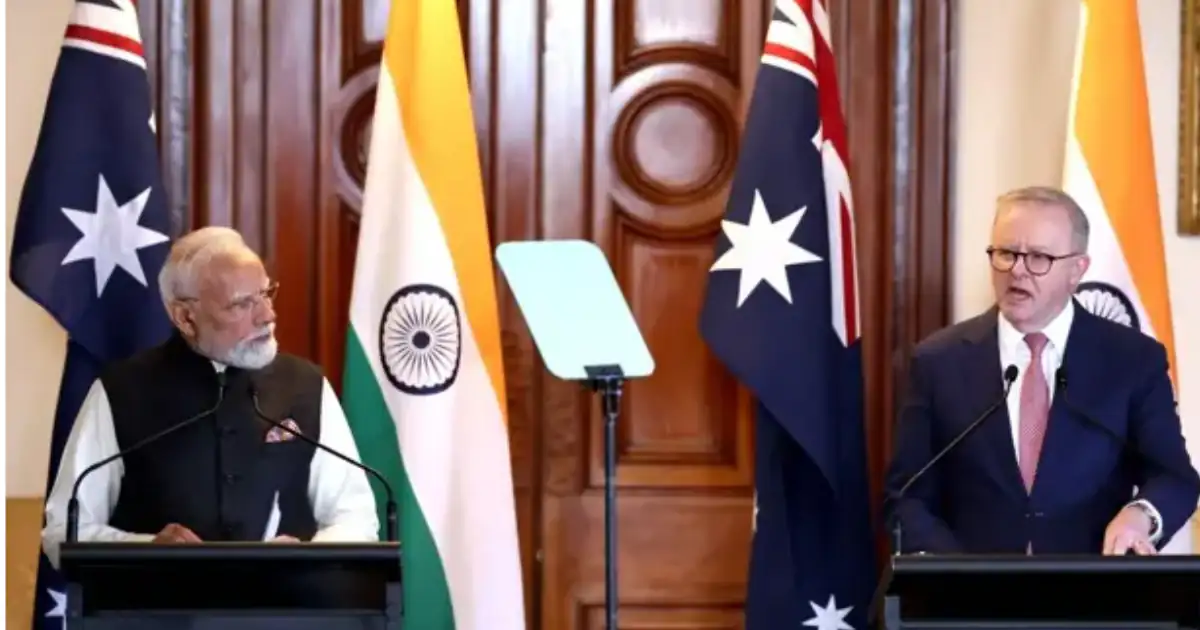
India and Australia signed a long-term uranium supply agreement on July 9, 2026, during talks between Prime Minister Narendra Modi and his Australian counterpart Anthony Albanese, finally operationalising the Civil Nuclear Cooperation Agreement the two countries had signed nearly twelve years earlier, in 2014.
"We have signed an important agreement on nuclear energy. This will pave the way for uranium supplies from Australia to India and give our clean energy objectives fresh momentum," Modi said after the talks.
The arrangement permits Australian uranium exports to India strictly for civilian power generation, governed by International Atomic Energy Agency safeguards designed to prevent diversion toward weapons use, a longstanding Australian condition given India's status outside the Non-Proliferation Treaty. The deal follows similarly structured long-term agreements with Canada and Kazakhstan signed earlier this year, underscoring a deliberate strategy of supplier diversification rather than reliance on any single source.
India's Nuclear Expansion Ambition
The urgency behind this diversification traces back to India's target of expanding civil nuclear capacity to 100 gigawatt-electric by 2047, a goal that required the government to open the tightly regulated civil nuclear sector to greater private participation last year. Meeting this target is described as less a policy choice than an arithmetic necessity, since the country's current installed base is a fraction of what the 2047 target demands.
Why Domestic Reserves Fall Short
Uranium fuel production runs through several stages, mining and milling, conversion, enrichment where required, and fuel fabrication, before reactors can use it. India's own Pressurised Heavy Water Reactors run on natural uranium sourced through a mix of domestic output and imports, while its Light Water Reactors at Tarapur and Kudankulam depend entirely on imported enriched uranium. Although India holds an estimated 4.3 lakh tonnes of uranium oxide reserves spread across forty-seven deposits in states including Andhra Pradesh, Jharkhand, and Rajasthan, with the Uranium Corporation of India Ltd operating the principal mines at Jaduguda, Turamdih, and Tummalapalle, domestic sources cover the fuel requirement for only 2.4 GWe of the country's present 8.7 GWe capacity. A Ministry of Power committee tasked with charting the path to 100 GW estimated the country will need an additional 8,029 tonnes of natural uranium and 1,045 tonnes of enriched uranium every year by 2047, a gap domestic mining alone cannot close.
The Economics of Import Dependence
The core reason for this reliance is cost rather than scarcity: processing India's own uranium ore into usable concentrate costs three to four times more than importing it, a consequence of the comparatively poor grade of domestic deposits. Since the Nuclear Suppliers Group granted India a clean waiver in 2008, making it the only non-NPT state permitted to trade in nuclear fuel, the country has imported a cumulative 18,842.60 metric tonnes of uranium through 2024-25 for reactors under IAEA safeguards. In 2024-25 alone, imported uranium accounted for 39,180 million units out of the 56,631.48 million units of electricity generated by India's nuclear plants that year.
Widening the Supplier Base
India currently sources uranium from Russia and Uzbekistan, but 2026 has seen a marked push to widen this base. Canada's Cameco signed a $2.6-billion agreement in March to deliver nearly 22 million pounds of uranium ore concentrate between 2027 and 2035.
Cameco's chief executive Tim Gitzel noted at the signing that India "is embarking on an ambitious nuclear expansion to power its development plans," which he said was not possible "without a stable supply of uranium fuel."
Kazakhstan's Kazatomprom, the world's largest uranium producer, agreed in February to a substantial supply volume, while France and the United States have also supplied uranium concentrates to India in recent years, restoring a supplier relationship with Cameco and Kazatomprom that had lapsed since 2020-21.
Significance and the Way Forward
This diversification reduces India's vulnerability to any single geopolitical disruption in its fuel supply chain, a meaningful consideration given how concentrated global uranium production remains among a handful of producing states. Yet the Ministry of Power committee has cautioned that a worldwide resurgence in nuclear power investment could push international uranium prices higher in the years ahead, and has recommended that India simultaneously scale up domestic production, even at higher cost, through mechanisms such as additional government equity infusion into UCIL, to safeguard long-term energy security rather than depending entirely on the goodwill and pricing of external suppliers.
Conclusion
The Australia deal, layered onto recent agreements with Canada and Kazakhstan, reflects India's recognition that its 100 GWe nuclear ambition by 2047 cannot rest on domestic reserves alone, given both their limited scale and the economics of extracting low-grade ore. Diversifying import sources buys India resilience against supply shocks and strengthens its strategic partnerships with key uranium producers, but it does not eliminate the underlying dependence. The durability of India's nuclear expansion will ultimately depend on striking a careful balance between securing reliable external fuel and investing steadily in domestic production capacity, so that energy security does not become hostage to the price cycles or political choices of a small set of foreign suppliers.