Senegal: West African Nation and New Chair of ECOWAS
Senegal's President, Bassirou Faye, has recently been elected as the Chairman of the Economic Community of West African States (ECOWAS), highlighting Senegal's growing role in regional diplomacy and cooperation in West Africa.
Senegal's Bassirou Diomaye Faye Elected ECOWAS Chairman
The Development
Senegal's President, Bassirou Diomaye Faye, has been elected the new Chairman of the Economic Community of West African States (ECOWAS). Faye assumed the position during the 69th Ordinary Session of the Authority of Heads of State and Government, held in Lungi/Freetown, Sierra Leone, on 19 July 2026. He succeeds Sierra Leone's President Julius Maada Bio, who had held the position for a one-year term after taking over from Nigeria's President Bola Tinubu in June 2025. In a notable double achievement for Senegal at the same summit, Birame Diop, the country's former Minister of the Armed Forces, was elected President of the ECOWAS Commission for the 2026–2030 term, succeeding Gambian diplomat Omar Touray — marking the first time since ECOWAS's founding in 1975 that a Senegalese national has led the Commission.
"After fulfilling my mandatory one-year term as Chairman of the ECOWAS Authority, I am delighted to pass the mantle of leadership to my younger brother, His Excellency Bassirou Diomaye Diakhar Faye, President of the Republic of Senegal."
Bio's remarks on handing over leadership underline the ceremonial continuity that ECOWAS's rotating chairmanship is designed to preserve even amid the bloc's structural strains. Faye, at 46, becomes one of the younger heads of state to lead the 15-member regional bloc, and reportedly accepted the role "with humility," emphasising fraternity and unity among member states going forward.
The Institutional Context — ECOWAS Under Strain
Faye takes charge at what is widely described as a pivotal and difficult moment for West African regional integration. ECOWAS continues to confront overlapping crises: jihadist and terrorist violence across the Sahel, repeated instances of democratic backsliding and military takeovers, and — most consequentially — the formal withdrawal of Mali, Burkina Faso, and Niger from the organisation after they aligned instead with the Alliance of Sahel States (AES). This withdrawal has fractured the bloc's geographic and diplomatic coherence, since these three landlocked states sit at the heart of West Africa's security architecture.
As the incoming Chairman, Faye is expected to prioritise rebuilding channels of dialogue with the breakaway AES trio rather than deepening the rupture, while simultaneously pushing internal reforms on governance, accountability, and youth participation within the remaining member states. His own political rise — as a reformist elected in 2024 on a platform of sovereignty and anti-corruption — is being read by observers as symbolic of a broader generational shift in West African leadership, even as it now positions him to manage an organisation grappling with exactly the sovereignty-versus-integration tensions that shaped his own campaign.
About Senegal — Location and Boundaries
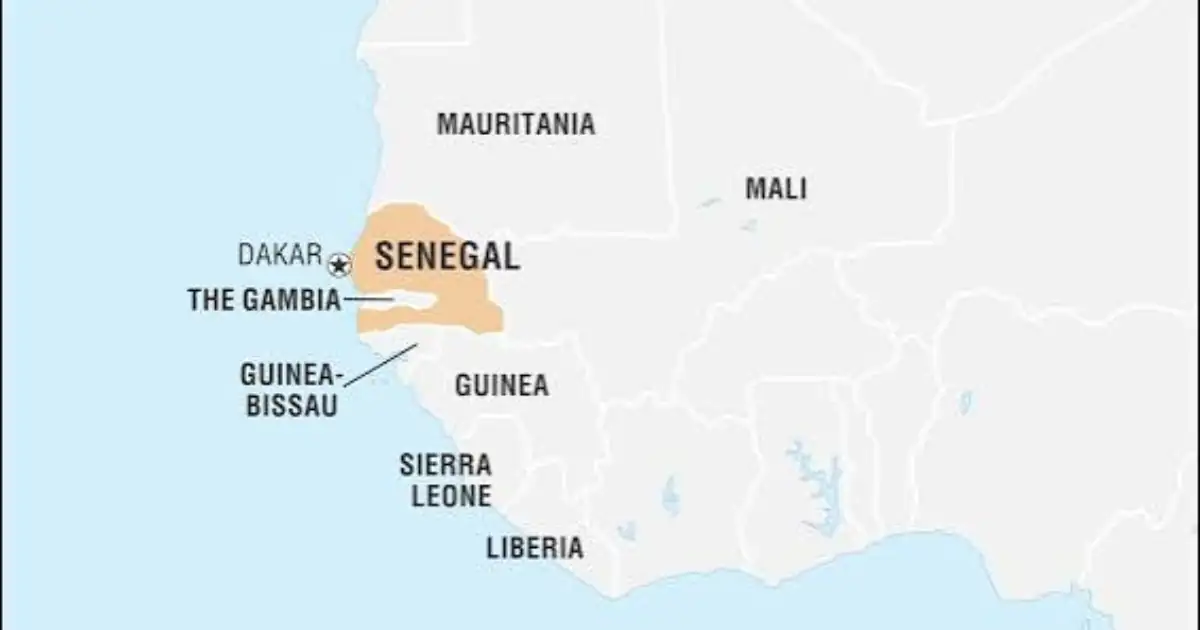
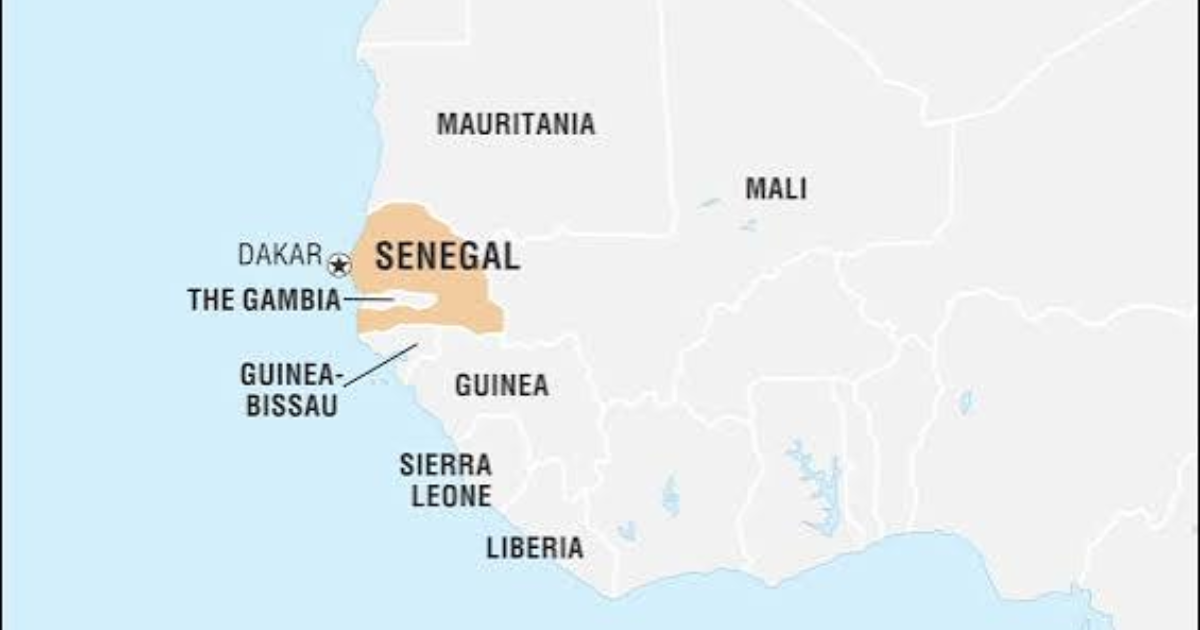
Senegal is a West African nation situated at the westernmost edge of the African mainland. It shares land borders with four countries: Mauritania to the north, Mali to the east, Guinea to the southeast, and Guinea-Bissau to the southwest. Its western edge is defined by a maritime border with the Atlantic Ocean. A distinctive feature of Senegal's geography is that it almost entirely surrounds The Gambia, a narrow nation confined to the banks of the Gambia River, whose only non-Senegalese frontier is its short Atlantic coastline. This unusual enclave-like arrangement, a legacy of British and French colonial boundary-drawing along the Gambia River, means Senegal's southern Casamance region is physically separated from the rest of the country by Gambian territory. Dakar serves as Senegal's capital, situated on the Cap-Vert Peninsula.
The Cap-Vert Peninsula, on which Dakar sits, marks the westernmost point of the entire African continent — a geographic distinction that has historically made Dakar a key Atlantic maritime and strategic outpost.
Geographical and Physical Features
Senegal is largely a flat country, lying within a depression known as the Senegal-Mauritanian Basin. Its territory is conventionally divided into four major geographical regions. The Cap-Vert Peninsula forms the coastal, westernmost extremity of Africa and hosts the capital. The Sahelian Zone lies further inland and represents a transitional belt between the Sahara to the north and more fertile lands to the south; this zone contains the Baunez Ridge, rising to 648 metres, one of the country's higher points. The Sudanian Zone extends across the country's central-southern belt, while the Casamance region, separated from the rest of Senegal by The Gambia, is distinguished by higher rainfall and denser vegetation.
Senegal's climate is broadly tropical and dry, though conditions vary from arid Sahelian patterns in the north to more humid tropical conditions in the south. The country's river systems are central to its geography and economy: the Senegal River forms the natural northern border with Mauritania; the Gambia River, though flowing largely through Gambian territory, originates and partly flows through Senegal; and the Saloum Delta forms an important estuarine and biodiversity-rich zone along the coast.
Resource Base and Strategic Relevance
Senegal possesses a resource base disproportionate to its size, particularly in critical minerals. It holds significant reserves of titanium and zirconium — both used in high-value industrial, aerospace, and defence applications — alongside gold and phosphate deposits. Phosphate, in particular, underpins Senegal's chemical and fertiliser industries. This mineral wealth adds an economic dimension to Senegal's rising diplomatic profile: as Faye now chairs ECOWAS, Senegal's position as a resource-holder with critical-mineral leverage intersects with its new political weight in shaping regional economic and industrial policy.
Significance and Way Forward
Faye's chairmanship carries significance on multiple fronts relevant to India's and the wider world's engagement with West Africa. First, it reflects a generational transition in African political leadership, with younger, reform-oriented leaders increasingly occupying positions once dominated by longer-tenured incumbents — a trend with implications for how regional blocs like ECOWAS negotiate sovereignty, external partnerships, and internal reform. Second, the twin Senegalese leadership of both the ECOWAS Chairmanship and, from September 2026, the ECOWAS Commission Presidency under Birame Diop, concentrates unusual influence in Dakar's hands at a moment when the bloc's credibility is being tested by the AES withdrawal.
The way forward for ECOWAS under Faye will likely hinge on whether dialogue can be sustained with Mali, Burkina Faso, and Niger without either side making the rupture permanent, and on whether internal reforms — particularly around free movement, economic integration, and democratic norms — can be advanced convincingly enough to reassure both member states and external partners of the bloc's continued relevance. For India, Senegal's growing critical-mineral profile alongside its enhanced regional diplomatic standing makes it a country of rising interest for future resource-security and Africa-outreach engagement.
Conclusion
The election of Bassirou Diomaye Faye as ECOWAS Chairman, coming alongside Senegal's simultaneous capture of the Commission Presidency, marks a moment of considerable symbolic and substantive weight for both Senegal and the regional bloc. It places a young, reform-minded leader at the helm of an organisation confronting perhaps its most serious existential test since its founding — the departure of three core member states — while simultaneously elevating Senegal's own geopolitical and economic standing in West Africa. How Faye balances the competing imperatives of reconciliation with the Sahel breakaway states and continued deepening of integration among remaining members will likely define both his tenure and the near-term trajectory of West African regional cooperation.