Justice Yashwant Varma Case Highlights Judicial Accountability and Resignation Loophole
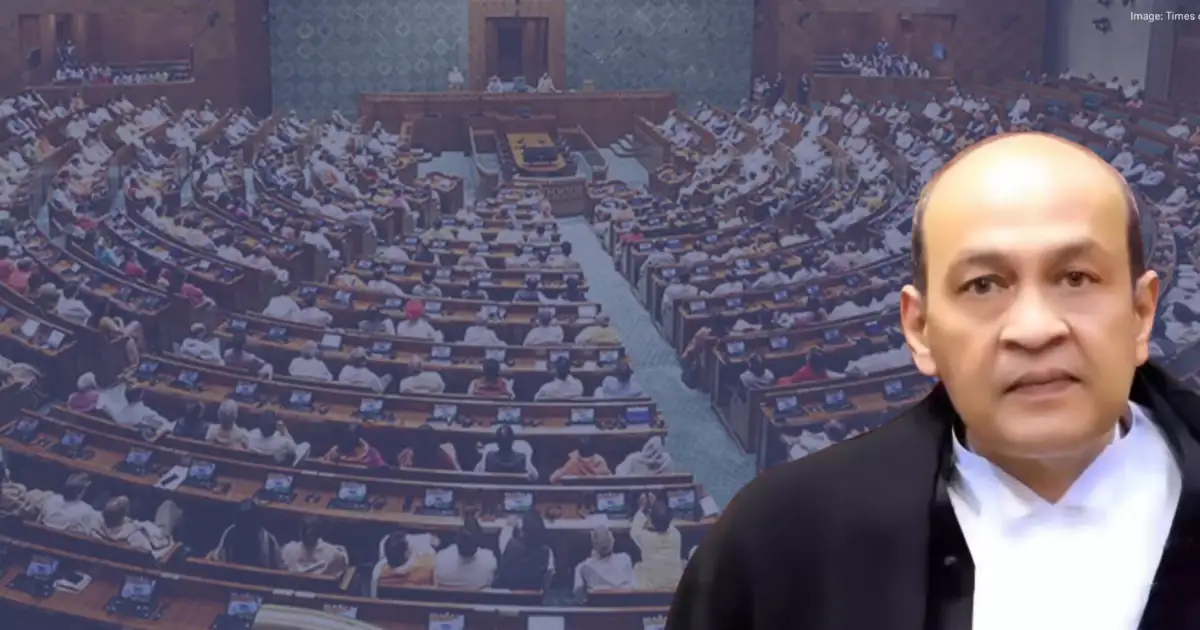
The Inquiry Committee report against former Allahabad and Delhi High Court Judge Justice Yashwant Varma is set to be placed before Parliament, bringing renewed focus on judicial accountability, judicial independence, and the constitutional provisions governing the resignation and removal of judges.
Justice Yashwant Varma Report: Judicial Accountability and the Resignation Loophole
Background of the Controversy
The Yashwant Varma case originated in March 2025 with the discovery of partially burnt currency notes in an outhouse at his official residence in Delhi, then serving as a judge of the Delhi High Court. The Chief Justice of India constituted an in-house committee that indicted him, following which he was repatriated to the Allahabad High Court. The Lok Sabha Speaker subsequently accepted a removal motion signed by 146 members of Parliament across party lines and, in August 2025, set up a three-member statutory committee under the Judges (Inquiry) Act, 1968 to investigate the charges of misbehaviour. Justice Varma challenged the constitution of this committee before the Supreme Court, but the Court found no illegality in the Speaker's action and declined to interfere. Before the inquiry could conclude, Justice Varma tendered his resignation to the President on 9 April 2026, having withdrawn from the proceedings on grounds that he was denied a fair opportunity to cross-examine witnesses. The committee nonetheless continued the process ex parte and submitted its findings to the Speaker in May 2026, with the report now set to be tabled in Parliament during the ongoing Monsoon Session.
The Constitutional Power to Resign at Will
At the heart of the controversy lies a distinctive constitutional feature: thirteen constitutional functionaries, including judges of the Supreme Court and High Courts, the President, the Vice-President, and Governors among others, possess the power to resign at will, without their resignation requiring acceptance by any authority. Such functionaries may resign merely by writing under their hand to a specified authority, and the resignation takes effect immediately upon submission. This stands in deliberate contrast to the position of legislators, whose resignations are subject to acceptance — by the Speaker of the Lok Sabha or the Chairman of the Rajya Sabha under Article 101(3)(b) for Members of Parliament, and by the corresponding presiding officers under Article 190(3)(b) for members of State Legislatures.
The Gopal Chandra Misra Precedent
"The effectiveness of the resignation does not depend upon acceptance by the President."
This principle was authoritatively settled by a five-judge Constitution Bench in Union of India vs Gopal Chandra Misra (1978), which unanimously held that the resignation of Supreme Court and High Court judges operates ex proprio vigore, meaning it takes automatic effect without requiring any external act of acceptance. Since 2017, at least twelve High Court judges have resigned under this provision, and Justice Dalveer Bhandari similarly resigned from the Supreme Court in 2012 to join the International Court of Justice, with these precedents having been handled without any recorded departure from the settled legal position.
The Present Administrative Anomaly
Three months after his resignation took automatic effect, Justice Varma continued to be listed as a sitting judge on the websites of both the Allahabad High Court and the Union government's Department of Justice. Given the settled position in Gopal Chandra Misra that no presidential acceptance is required for a judge's resignation to take effect, this continued listing rests on no legal basis and represents an unexplained administrative lapse rather than any genuine constitutional ambiguity.
Whether the Report Can Still Be Discussed
The resignation raises a more consequential legal question: does the Inquiry Committee's report survive it? Since the report pertains to conduct that occurred while Justice Varma still held judicial office, the statutory duty to lay it before Parliament remains unaffected by his subsequent resignation, and the public retains a legitimate interest in knowing whether the committee found proved misbehaviour against a sitting judge of a constitutional court. However, the report's practical consequences are far more limited than they would have been had Varma remained in office. Even if the report finds him guilty of the charges, no motion for his removal can any longer be moved, since he no longer holds the office of a judge and therefore cannot be removed from one. Under Section 6 of the Judges (Inquiry) Act, the report is meant to be discussed in conjunction with the removal motion — and since that motion has lapsed with the resignation, the report itself cannot be discussed by Parliament under the Act's own terms, even though it is tabled and made public.
The Accountability Loophole
This sequence exposes what many legal experts regard as a structural weakness in India's framework for judicial accountability: a judge facing serious charges can resign at will before Parliament takes up the removal motion, effectively halting the entire accountability process at the final stage and denying the public any authoritative parliamentary verdict on the allegations, even where an inquiry has already gathered extensive evidence against the judge.
The Case for Constitutional Amendment
Legal experts suggest that this gap is best remedied through constitutional amendment rather than through executive or judicial interpretation, since reading restrictions into an admittedly silent constitutional text to suit the convenience of Parliament or the Executive would itself run against the rule of law. The proposed reform envisages three elements: making a judge's resignation subject to acceptance specifically during the pendency of removal proceedings; vesting the power to accept such a resignation in the Chief Justice of India rather than the President, so as to keep the safeguard within the judiciary itself and preserve judicial independence; and expressly empowering Parliament to discuss the Inquiry Committee's report despite the judge's resignation, so that public accountability is not extinguished by a well-timed exit.
Significance and Way Forward
The episode illustrates the difficulty of balancing two constitutional values that pull in different directions. The power to resign at will remains an essential safeguard against coercion of judges by the executive or legislature, and any reform must preserve this protection rather than dilute it. At the same time, unconditional exit at will, when exercised at the eleventh hour of a removal proceeding, allows serious allegations against constitutional functionaries to go permanently unresolved in the eyes of Parliament and the public. Vesting the power to accept a mid-proceeding resignation in the Chief Justice of India, rather than in the executive, offers a workable middle path: it closes the accountability gap without handing the judiciary's independence over to the political branches. Until such an amendment is enacted, cases like Justice Varma's will continue to end in an unsatisfying limbo — a report that is public but institutionally inert.
Conclusion
The Yashwant Varma case has laid bare a genuine structural gap between judicial independence and judicial accountability in India's constitutional design. The power to resign at will, rightly conceived as a shield against coercion, has in this instance also functioned as an exit route from scrutiny at the very moment scrutiny was closest to concluding. Restoring public confidence in judicial accountability mechanisms will require Parliament to address this loophole through careful constitutional amendment, one that safeguards judicial independence by keeping the power of acceptance within the judiciary itself, while ensuring that the findings of a statutory inquiry are never rendered a dead letter simply because the judge concerned chose to resign first.