Samudra Pradakshina: India Completes First Tri-Service All-Women Circumnavigation Sailing Expedition
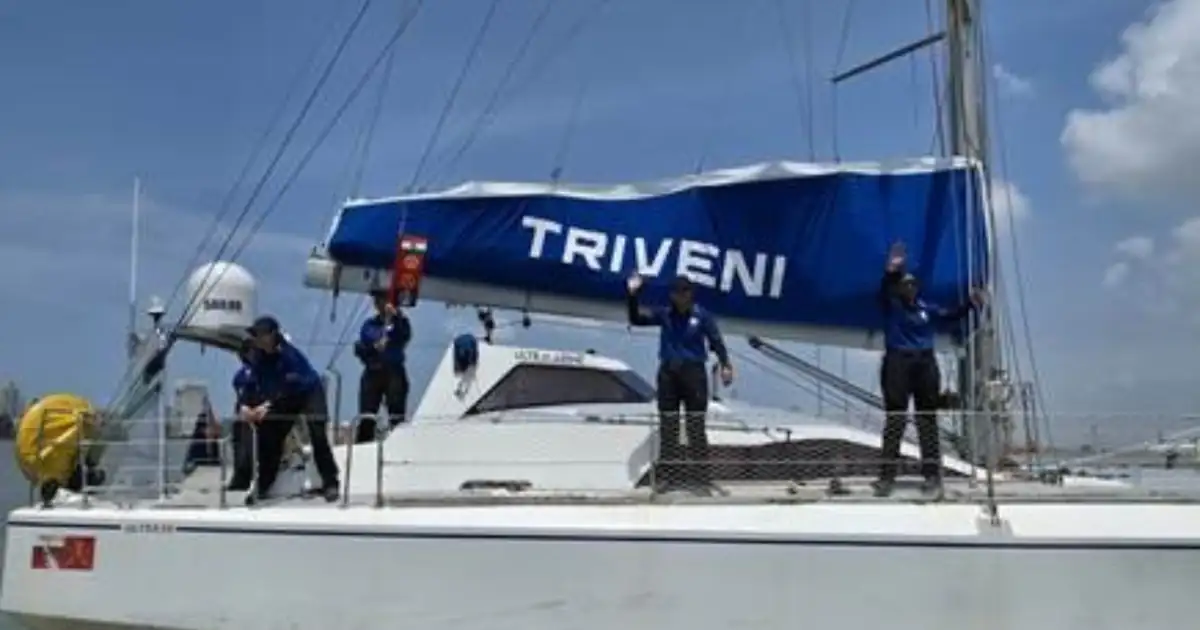
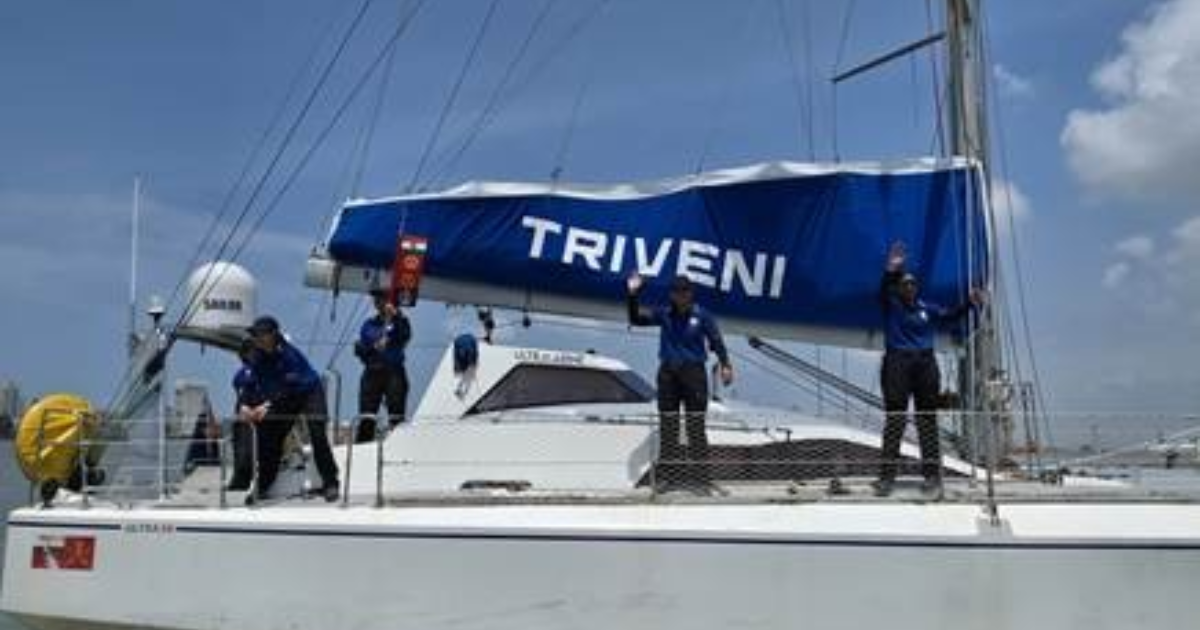
Samudra Pradakshina is the first-ever Tri-service all-women circumnavigation sailing expedition undertaken by the Indian Armed Forces.
Samudra Pradakshina: India's First Tri-Service All-Women Circumnavigation
Defence Minister Rajnath Singh recently flagged in 'Samudra Pradakshina' through video conferencing, marking the successful completion of the world's first Tri-service all-women circumnavigation sailing expedition — a mission that brought together officers of the Army, Navy, and Air Force on a single seaborne undertaking and closed a chapter that began with considerable fanfare nearly a year earlier.
Genesis and Flag-Off
The expedition was virtually flagged off by Rajnath Singh from South Block on 11 September 2025, sailing from Mumbai's Gateway of India under the leadership of Lieutenant Colonel Anuja Varudkar of the Indian Army, with Squadron Leader Shraddha P. Raju of the Indian Air Force serving as Deputy Expedition Leader. At the time of departure, the Defence Minister described the voyage as a glowing symbol of Nari Shakti and of the collective strength and jointness of the three Services, framing it also as an embodiment of Aatmanirbhar Bharat given that the vessel itself, IASV Triveni, is an indigenously built fifty-foot yacht constructed in Puducherry.
During the expedition, our officers may face numerous challenges, but their flame of determination will pierce through the darkness.
The Voyage and Its Completion
Nine women officers of the three Services returned to Mumbai on 22 July 2026 aboard IASV Triveni, having completed a 314-day voyage that covered nearly 25,500 nautical miles across four oceans. The expedition fulfilled every internationally recognised criterion for a circumnavigation: crossing all meridians of longitude, crossing the Equator twice, crossing the International Date Line, and rounding the Three Great Capes — Cape Leeuwin off Australia, Cape Horn at the southern tip of South America, and the Cape of Good Hope in Africa. Passage through the formidable Drake Passage and the rounding of Cape Horn earned the crew membership of the Cape Horners fraternity, an honour reserved for sailors who successfully navigate one of the world's most demanding maritime passages.
What Made the Mission Possible
Behind the voyage's success lay nearly two years of intensive training and meticulous planning, backed throughout by a dedicated round-the-clock, shore-based support network. The crew worked in continuous rotation — four hours on watch, four hours off — cycling through navigation, sail handling, cooking, and repair duties while contending with fatigue and unpredictable weather across some of the planet's most hazardous waters, including the Southern Ocean. The mission also carried a scientific dimension beyond seamanship: in collaboration with the National Institute of Oceanography, the crew studied microplastics and documented marine biodiversity along the route, lending the voyage an environmental research value alongside its military and symbolic significance.
Significance
Samudra Pradakshina extends a lineage of Indian naval sailing achievements that includes the earlier double-handed circumnavigation by Lieutenant Commanders Dilna K and Rupa A aboard INS Tarini, but distinguishes itself by drawing officers from all three Services rather than the Navy alone — a structural choice that let the mission double as a demonstration of tri-Service jointness rather than a purely maritime feat. It also reinforces a broader trend of women stepping into demanding operational leadership roles within the armed forces, a trajectory that runs parallel to expanding combat and command opportunities for women officers across the services. Diplomatically, the four international port calls along the route gave the crew occasion to project India's culture, values, and defence self-reliance to foreign audiences, turning the expedition into a quiet instrument of maritime outreach as much as an athletic and naval accomplishment.
Conclusion
Samudra Pradakshina stands as more than a sailing record; it is a demonstration of what sustained institutional investment in training, coordination across service branches, and unwavering shore-based support can achieve when directed toward a genuinely difficult goal. In completing every internationally recognised benchmark of circumnavigation and earning entry into the Cape Horners fraternity, the nine officers aboard IASV Triveni have set a benchmark not just for women in India's armed forces but for tri-Service collaboration as an operational model — one that other joint endeavours across the defence establishment may well look to replicate.