Fast-Track Courts: Can They Deliver Speedy Justice in Paper Leak Cases
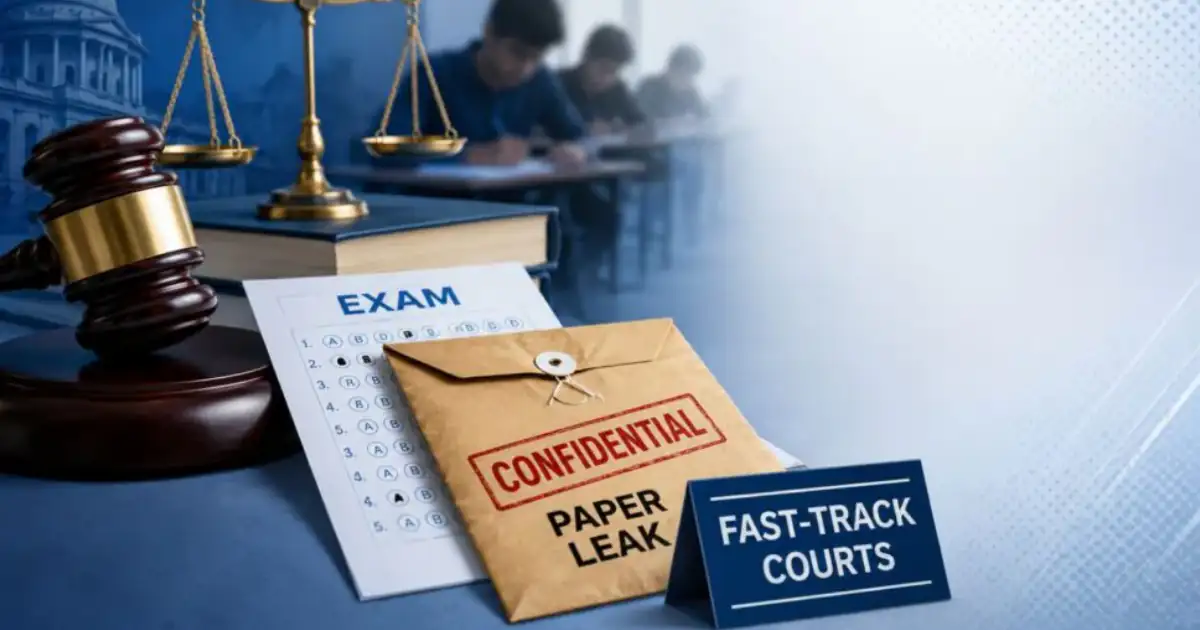
Prime Minister Narendra Modi has proposed the establishment of Fast-Track Courts (FTCs) to ensure speedy trial of paper leak cases amid widespread protests. The proposal has renewed attention on the effectiveness of FTCs in reducing judicial delays and improving the delivery of justice.
Fast-Track Courts and the Paper Leak Crisis: Can Speed Alone Fix Justice Delivery?
Amid escalating protests over the alleged NEET-UG paper leak, Prime Minister Narendra Modi has announced that the government will set up fast-track courts to try examination paper leak cases, pledging swift and stringent punishment for offenders. The move has reopened a long-standing debate: can fast-track courts genuinely deliver speedy justice given India's persistent judicial backlog, or do they risk becoming a symbolic gesture in response to public anger?
"Nothing is more important than the welfare and future of our youth! We have decided to set up fast-track courts to ensure swift and stringent punishment for those involved in paper leaks."
The announcement, made on X, came amid nationwide protests in Delhi and other cities, with details regarding the number of such courts, their territorial jurisdiction, and the timeline for setting them up not yet disclosed. Notably, fast-track courts are ordinarily established by state governments in consultation with the concerned High Courts, meaning the Centre's announcement will require considerable coordination to translate into functioning courtrooms.
What Are Fast-Track Courts?
FTCs are not the creation of a single central statute. Their origin lies in the recommendations of the Fourteenth Finance Commission (2015–2020), which proposed setting up 1,800 such courts to expedite trials involving heinous crimes like murder, kidnapping and extortion, property disputes pending over five years, and cases involving vulnerable groups such as women, children, senior citizens, persons with disabilities, and those with terminal illnesses.
A distinct category — Fast-Track Special Courts (FTSCs) — emerged later. Following a 2018 criminal law amendment and a Supreme Court directive, the Union government in 2019 launched a centrally sponsored scheme for FTSCs, partly funded through the Nirbhaya Fund, dedicated exclusively to time-bound trials of rape cases and offences under the POCSO Act.
Can a Special Court Be Carved Out for One Case?
Any move to create a special court for the NEET matter would have to clear a constitutional threshold. In State of West Bengal vs Anwar Ali Sarkar (1952), the Supreme Court struck down a law permitting arbitrary selection of cases for special courts on grounds of "speedier trial" alone, holding that speed by itself was too vague a justification under Article 14's equality guarantee. Any classification for fast-tracking must instead rest on a rational, objective basis — the nature of the offence or the vulnerability of the victims, for instance.
"Speed alone is too vague a justification for a special court." — Supreme Court, Anwar Ali Sarkar (1952)
India has precedent for case-specific special courts nonetheless: the Andhra Pradesh High Court set one up in 2010 for the Satyam Computer Services scam, and the Supreme Court directed a dedicated court, notified in March 2011 at Patiala House, for the 2G spectrum allocation scam. Whether the NEET case — currently being heard at Delhi's Rouse Avenue Courts — follows this path will depend on subsequent government and judicial decisions.
No Guaranteed Deadlines
Litigants have no automatic statutory right to a fixed trial completion date. The Bharatiya Nagarik Suraksha Sanhita recommends trials generally conclude within two years, and within two months for sexual offences, but these remain aspirational targets rather than enforceable rights. Each FTSC is expected to dispose of 41–42 cases per quarter, translating to at least 165 cases annually. This expectation echoes a settled constitutional position: in P. Rama Chandra Rao vs State of Karnataka (2002), a seven-judge Constitution Bench ruled it "neither advisable nor judicially permissible" to prescribe a fixed outer limit for concluding criminal trials, holding that such rigidity would amount to impermissible judicial legislation.
Performance on the Ground
As of January 2026, 862 regular fast-track courts were functioning across 21 states and Union Territories, alongside 774 FTSCs — including 398 exclusive POCSO courts — spread across 29 states and UTs. The FTSC disposal rate stands at around 96 percent, and in 2024, 88,902 new cases were filed while 85,595 were resolved. An FTSC disposes of roughly 9.5 cases a month, nearly three times the 3.3 cases cleared monthly by a regular trial court of comparable jurisdiction. Yet the backlog has not disappeared: over 2.4 lakh cases remained pending in FTSCs by the end of 2023, underscoring that faster disposal has not kept pace with rising case inflow.
Why Delays Persist
The Ministry of Law and Justice, responding in the Lok Sabha in March 2026, attributed continuing delays to a mix of factors — infrastructure availability, case complexity, investigation quality, the nature of evidence, and the level of cooperation among the bar, investigating agencies, forensic support staff, witnesses, and litigants. Legal experts also point to uneven outcomes across subject areas: FTCs handling POCSO and IPC matters contend with heavy case volumes and judge shortages, while courts under the Prevention of Corruption Act show comparatively stronger performance. Separately, legal commentators have flagged that a fast-track court can only move as fast as the investigation feeding it, since paper leak networks typically span multiple states and rely on encrypted communication and local intermediaries, making evidence-gathering considerably harder than in routine criminal cases.
Significance and Way Forward
The proposal signals the government's strongest legal response yet to the paper leak controversy, but its real test lies beyond the announcement itself. Speed of trial depends as much on investigative capacity, forensic support, and judicial infrastructure as on the existence of a fast-track label. Unless charge-sheet filing timelines, judge vacancies, and case-selection criteria consistent with Article 14 are addressed simultaneously, a fast-track court announced today could face the same pendency pressures that already weigh on the existing FTSC network.
Conclusion
Fast-track courts have demonstrably outperformed regular courts in disposal rates, but their record also shows that speed without adequate infrastructure, staffing, and investigative support cannot fully resolve the deeper pendency crisis. The PM's announcement addresses public anger over the paper leak controversy in the short term, but its lasting value as a justice-delivery reform will depend on whether it moves beyond symbolism into a properly resourced, constitutionally sound institutional mechanism.