RBI Moves Towards Polymer Banknotes with Global EOI
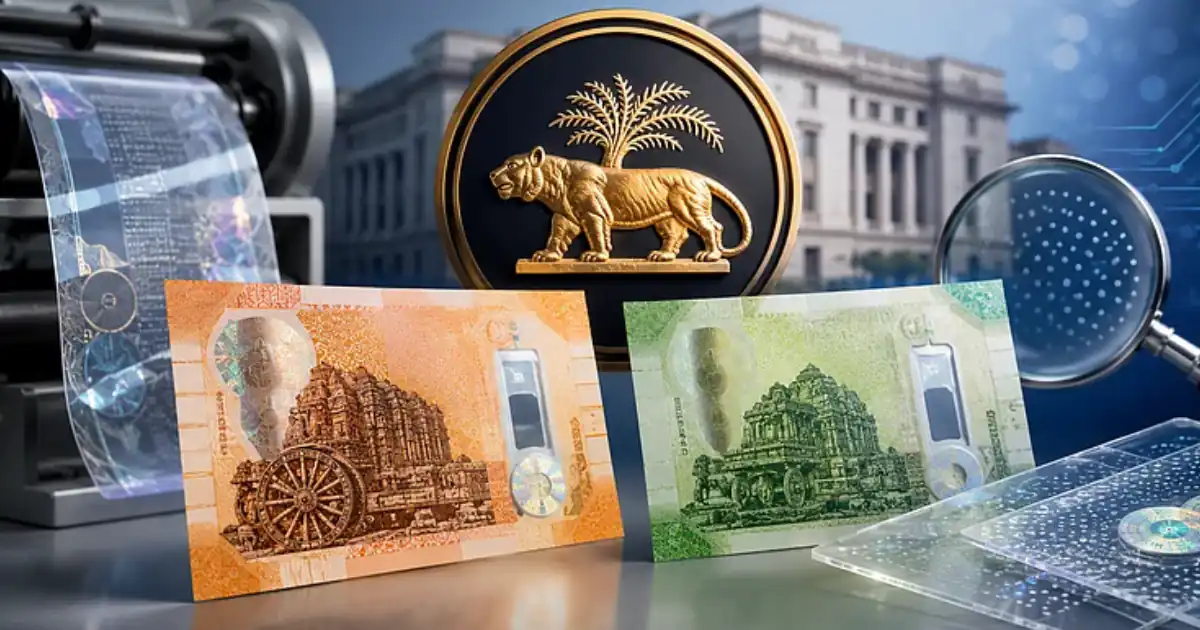
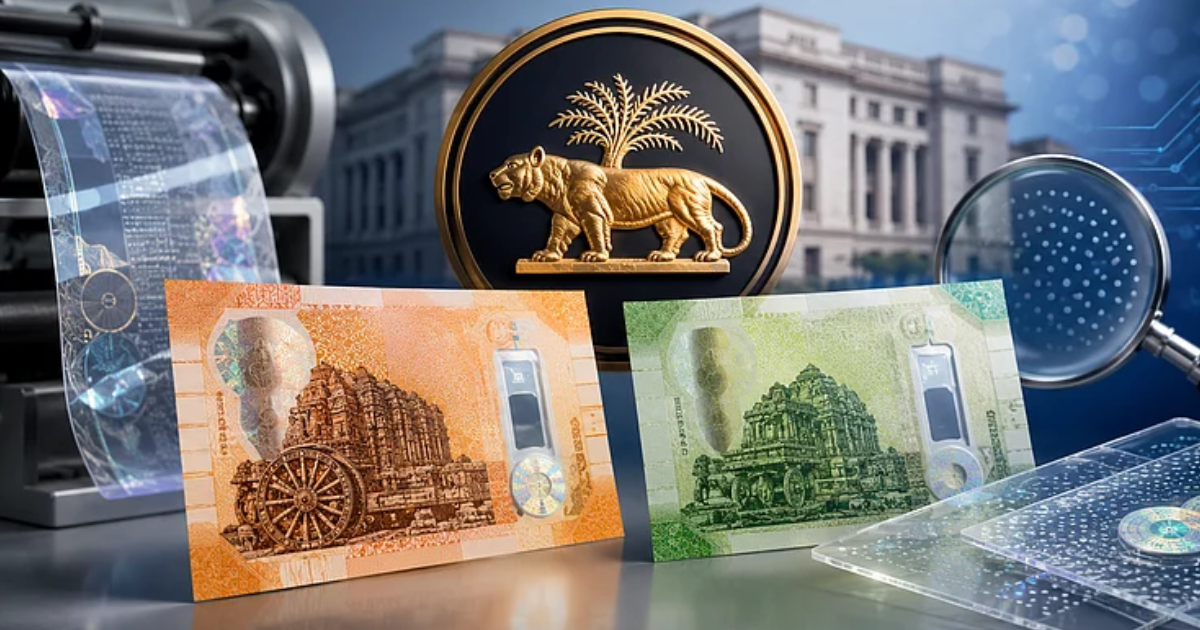
The Reserve Bank of India (RBI), through its wholly owned currency-printing subsidiary Bharatiya Reserve Bank Note Mudran Pvt. Ltd. (BRBNMPL), has invited global Expressions of Interest (EOI) for the supply of Biaxially Oriented Polypropylene (BOPP) polymer substrates with advanced security features.
Plastic in Your Pocket: RBI's Renewed Push for Polymer Currency
The Reserve Bank of India, through its currency-printing arm Bharatiya Reserve Bank Note Mudran Private Limited (BRBNMPL), has floated a global Expression of Interest inviting manufacturers to supply Biaxially Oriented Polypropylene (BOPP) polymer substrates with embedded security features. The EOI, released on 17 July 2026, seeks an indicative quantity of 68,000 reams of BOPP-based polymer substrate — split into 34,000 reams each for two denominations, with every ream comprising 500 sheets. This marks India's most concrete step towards polymer banknotes since the idea was first floated back in 2009.
What the EOI Specifies
BRBNMPL has laid out fairly detailed technical and eligibility conditions for prospective suppliers. The substrate must carry security features such as a clear window with portrait, metallic numeral, magnetic pseudo thread, shadow image, and iridescent pattern, suitable for printing at BRBNMPL and SPMCIL presses.
"We seek competitive offers from manufacturers and suppliers of Opacified Polymer Substrate with security features suitable for printing banknotes." — BRBNMPL Expression of Interest
Sources indicate the lower denominations of ₹10 and ₹20 — which see the heaviest circulation and physical wear — are likely to be the starting point. Bidders, whether domestic or global, must have at least three years' experience supplying polymer substrate with security features to a central bank or banknote/security printing organisation, and must be able to offer at least 30 percent of the indicative quantity to qualify, with proposals due by mid-August 2026. Notably, BRBNMPL's stated aim is to establish domestic manufacturing through technology transfer rather than simply importing the material, and the current tender is understood to be an initial step rather than a full commercial procurement order.
Why RBI Is Considering the Shift
Durability is the central pitch: polymer notes last 2.5 to 4 times longer than conventional cotton-paper notes, which would reduce replacement frequency under RBI's Clean Note Policy. Security is the second driver — polymer surfaces can carry transparent windows, metallic numerals, magnetic pseudo-threads, holograms, shadow images, iridescent patterns, and tactile markings for visually impaired users, features considerably harder to counterfeit than paper equivalents. Better currency management follows from both: despite higher upfront manufacturing costs, fewer replacement cycles could ease printing, transport, storage, and destruction expenditure over time.
The Economics Involved
RBI's currency management costs are substantial. Security printing expenditure stood at ₹5,101 crore in FY2023-24, rose to ₹6,373 crore in FY2024-25, and is estimated at ₹4,875 crore in FY2025-26, with India destroying 20 to 24 billion soiled notes annually, mostly in lower denominations. Yet polymer is not cheap to begin with — it costs 30 to 60 percent more to manufacture than paper, and in several countries, production costs for low-value polymer notes have reached 20 to 24 percent of face value. Transition costs would also extend to recalibrating ATMs, currency sorting machines, vending machines, and cash-processing infrastructure across the country.
Weighing the Environmental Trade-off
A TERI study commissioned by RBI found that longer circulation life reduces overall manufacturing and transportation demand, and that polymer notes may carry a lower lifecycle carbon footprint than paper, with end-of-life notes recyclable into other plastic products. Set against this are genuine concerns: BOPP is derived from polypropylene, a petroleum-based product, meaning a higher initial carbon footprint, a need for specialised recycling infrastructure, and continued dependence on fossil-fuel-derived raw material.
Questions That Remain Open
India currently imports around one-fifth of its polypropylene requirement, exposing the currency-printing supply chain to crude oil price volatility — a risk sharpened by ongoing geopolitical tensions in West Asia — even as companies such as Reliance Industries and Indian Oil Corporation plan domestic capacity expansion.
There is also a deeper paradox to reckon with. UPI now processes over 24,000 crore transactions annually, accounting for nearly 85 percent of retail digital payments, yet currency in circulation has crossed ₹41 lakh crore in 2025-26, up from roughly ₹16-17 lakh crore a decade ago, with the currency-to-GDP ratio holding above 11 percent. This persistence of cash demand — driven by the large informal economy, uneven rural digital infrastructure, and cash's continuing role in financial inclusion — raises the question of how urgently a costly currency-format overhaul is needed even as digital payments surge.
A Decade in the Making
RBI first proposed polymer ₹10 notes in 2009. By 2012, pilots were planned across Kochi, Mysuru, Jaipur, Bhubaneswar, and Shimla to test performance under varied climatic conditions, but the project was shelved amid technological hurdles and the disruption of the 2016 demonetisation and subsequent currency redesign. The 2026 global EOI revives this dormant proposal, with field trials for ₹10 and ₹20 polymer notes now expected, and a realistic rollout window placed between late 2026 and early 2027, during which polymer notes would circulate alongside existing paper notes rather than replacing them outright.
Globally, the experience is instructive. Australia pioneered polymer currency and has fully transitioned to it, and roughly 60 countries — including Canada, the UK, New Zealand, Mexico, Brazil, Saudi Arabia, Romania, and Barbados — now use polymer banknotes in some form, generally reporting improved durability, stronger counterfeiting resistance, and lower lifecycle costs despite higher initial outlays.
Significance and Way Forward
A phased, evidence-led rollout appears the most prudent course: beginning with limited pilots in lower denominations, building domestic polymer-substrate manufacturing to cut import dependence, running thorough cost-benefit and environmental impact assessments, upgrading cash-handling infrastructure incrementally, and ensuring paper and polymer notes coexist without triggering demonetisation-style disruption. Aligning this transition with Digital India and financial-inclusion goals will matter as much as the material switch itself, since cash's persistence in India's informal economy means currency reform cannot be evaluated purely as a digitalisation footnote.
Conclusion
India's renewed push towards polymer currency reflects a genuine attempt to modernise durability, security, and lifecycle efficiency in cash management, but the underlying trade-offs — higher upfront costs, import dependence on petrochemical inputs, and unresolved environmental questions — demand a cautious, data-driven rollout rather than a wholesale switch. The real objective should not be substituting paper with plastic for its own sake, but building a currency system that is cost-effective, secure, and environmentally sound for India's evolving payments landscape.