Romania: Key Facts as Indian President Undertakes State Visit
The President of India recently held bilateral talks with the President of Romania during her State Visit to Romania, reaffirming the growing strategic partnership between the two countries. The discussions focused on strengthening cooperation in trade, defence, energy, technology, education, and people-to-people ties.
India-Romania Ties: President Murmu's Historic Bucharest Visit
President Droupadi Murmu held bilateral talks with Romanian President Nicusor Dan in Bucharest, in what marks the first State Visit by an Indian President to Romania in nearly three decades. The visit, on the final leg of a three-nation Eastern European tour covering Moldova, North Macedonia and Romania, has renewed focus on India's diplomatic outreach to a region increasingly relevant to its European Union engagement.
The Visit in Context
President Murmu reached Bucharest on 23 July 2026, on the last leg of her State Visits to Moldova, North Macedonia and Romania, and was warmly received at the airport by Romania's Foreign Minister Oana-Silvia Țoiu. At Cotroceni Palace — the official residence of Romania's President — she was accorded a ceremonial welcome and guard of honour before holding one-to-one and delegation-level talks with President Nicusor Dan covering all major dimensions of the India-Romania bilateral partnership.
"The two leaders held productive and forward-looking discussions covering the major dimensions of our bilateral partnership. They also exchanged perspectives on regional and global developments." — President's Secretariat, X
Beyond the formal talks, three Memoranda of Understanding were signed on the occasion, spanning science and technology cooperation, sports, and the establishment of a Chair of Indian Studies at the University of Bucharest. President Murmu was also scheduled to address the India-Romania Business Forum, and visit Romania's Parliament and the Bucharest University of Economic Studies before concluding her tour.
Why the Visit Matters
The Ministry of External Affairs has framed Romania's significance partly through the EU lens, noting the bilateral economic partnership stands to strengthen further following the conclusion of the India-EU Free Trade Agreement. Romania's own position — an EU and NATO member state sitting at the crossroads of Eastern Europe and the Black Sea — gives India a foothold for deepening trade, defence, and people-to-people ties in a region where its diplomatic presence has historically been thin. The visit followed stops in Moldova, itself a historic first for an Indian Head of State, underscoring a broader push to reinvigorate ties across the wider Eastern European neighbourhood.
About Romania: Geography and Profile
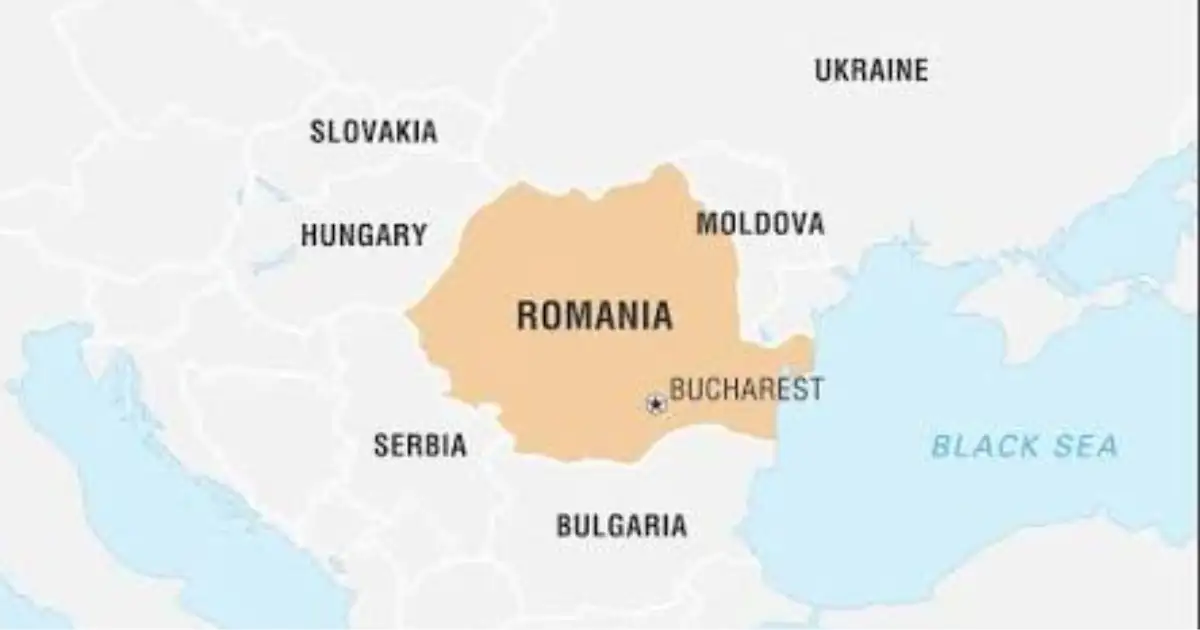
Romania is located in South Eastern Europe, sharing borders with Ukraine to the north, Moldova to the northeast, Bulgaria to the south, Serbia to the southwest, and Hungary to the west, with a maritime frontier along the Black Sea in the southeast. Its capital is Bucharest. The country joined NATO in 2004 and became a member of the European Union in 2007, anchoring it firmly within both the transatlantic security architecture and the European single market.
Romania's climate is temperate, marked by four distinct seasons, while its relief is dominated by the Carpathian Mountains, home to Mount Moldoveanu, the country's highest peak. Its river network includes the Danube, Arges, Tisza, and Prut, and its natural resource base spans petroleum, gold, silver, and uranium — endowments that give the country a distinct profile within the EU's eastern flank, both as an energy producer and a potential partner in critical minerals and nuclear cooperation.
Significance and Way Forward
For India, the visit signals an intent to broaden its European engagement beyond the traditional focus on Western Europe, using Romania's EU and NATO membership as a bridge into Eastern European markets and multilateral forums. The MoUs on science and technology, sports, and Indian Studies suggest an effort to build people-to-people and institutional linkages that can sustain the relationship beyond high-level visits. Whether this translates into substantive trade and investment growth will depend on follow-through — particularly on how the India-EU FTA, once concluded, is leveraged to deepen commercial ties with Romania specifically, and whether India's outreach to the wider Black Sea region continues at this pace.
Conclusion
President Murmu's visit to Bucharest, ending a three-decade gap in top-level bilateral engagement, reflects India's calibrated effort to widen its diplomatic and economic footprint in Eastern Europe at a moment when the EU's eastern members carry growing strategic weight. The real test will be whether the goodwill and agreements generated during this visit are converted into durable trade, technology, and educational partnerships in the years ahead, rather than remaining a one-off diplomatic milestone.