India–Tanzania Review Bilateral Ties; Key Facts About East African Nation
Recently, India and Tanzania reviewed bilateral cooperation across trade and investment, development partnership, defence, and security, highlighting the growing strategic importance of their relationship in the Indian Ocean Region.
India-Tanzania Bilateral Review: Deepening Ties Across Trade, Defence, and Development in East Africa
India and Tanzania recently reviewed the full spectrum of their bilateral relationship, with discussions spanning trade and investment, development partnership, defence and security cooperation, digital public infrastructure, agriculture, healthcare, and culture. The two countries held the 3rd Foreign Office Consultations in Dar es Salaam, led on the Indian side by Janesh Kain, Joint Secretary for East and Southern Africa in the Ministry of External Affairs, and on the Tanzanian side by Felister Rugambwa, Director of the Asia and Australasia Department in Tanzania's Ministry of Foreign Affairs and East African Cooperation.
"The two sides positively assessed recent expansion in bilateral trade and investment linkages and development partnership."
To sustain momentum in key sectors, both sides agreed to organise upcoming meetings of the Joint Commission Meeting and the Joint Defence Cooperation Committee at mutually convenient dates, and also agreed to hold the next round of Foreign Office Consultations in India. The discussions gave particular attention to the wide-ranging development partnership between the two countries, including the development of IIT Madras Zanzibar as a Centre of Excellence for Higher Education in Africa. This exchange followed closely on the heels of a separate high-level engagement: the President of Zanzibar, Hussein Ali Mwinyi, had earlier visited India from 17 to 20 July at the invitation of Vice President C.P. Radhakrishnan, during which the two leaders reviewed the full spectrum of India-Tanzania relations and explored cooperation in areas such as the blue economy, tourism, technology, health, and education.
Tanzania: Location and Political Geography
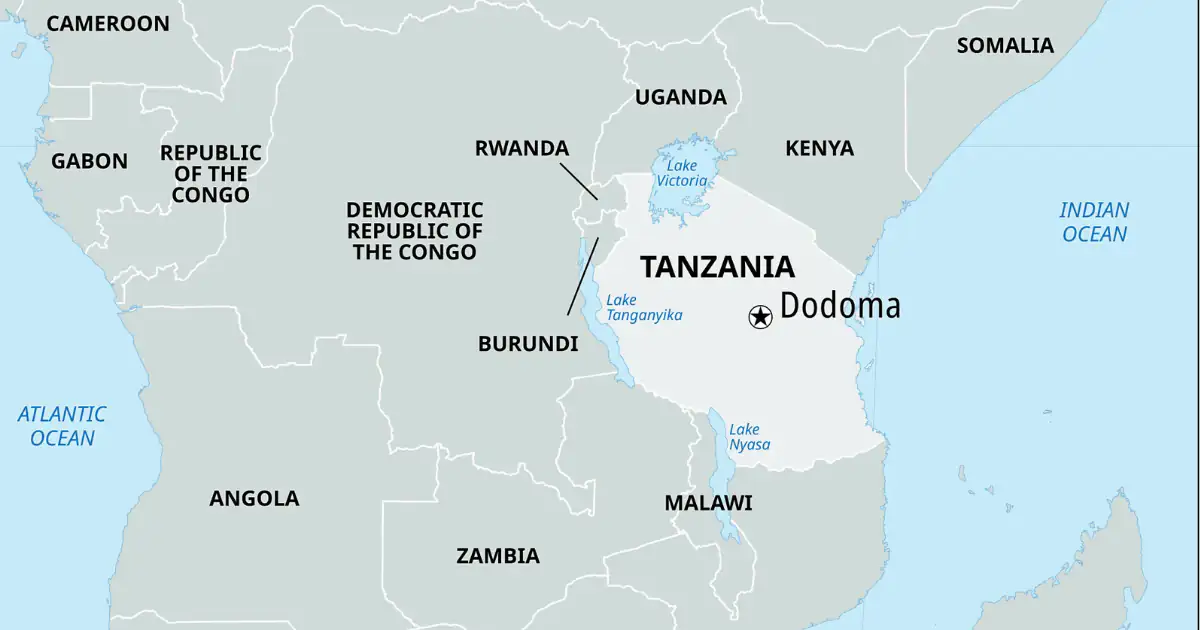
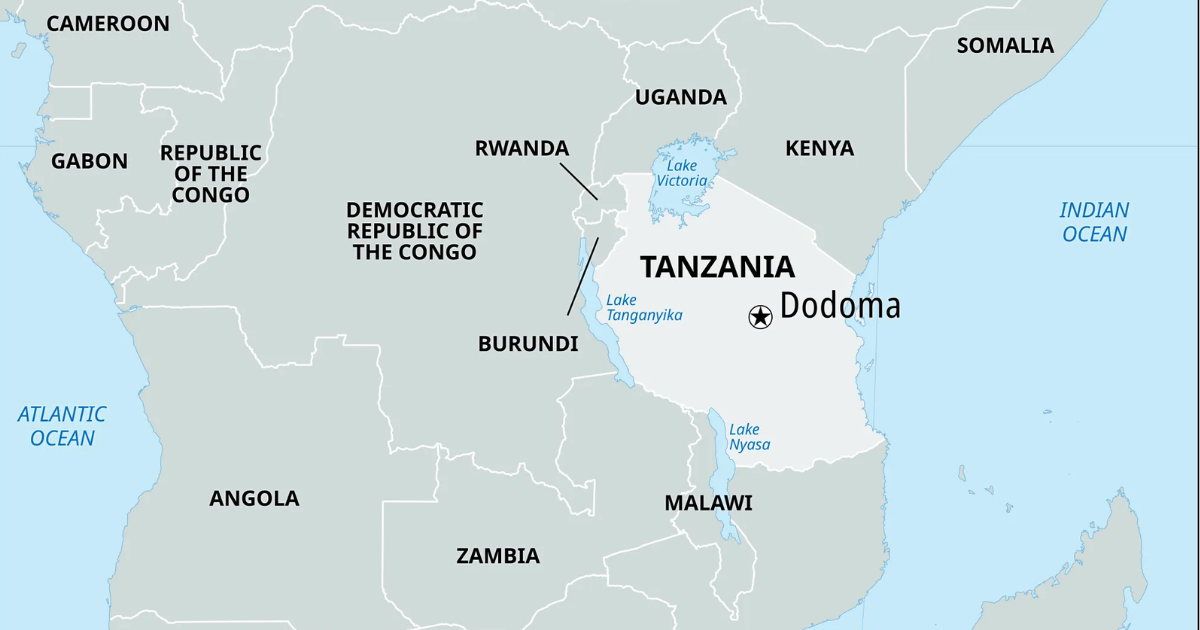
Understanding the weight of this partnership requires situating Tanzania within East Africa's geography. The country lies just south of the Equator and is bordered by eight nations, Kenya and Uganda to the north, Rwanda, Burundi, and the Democratic Republic of the Congo to the west, and Zambia, Malawi, and Mozambique to the south, giving it one of the most extensive land-border networks on the continent. Its eastern edge meets the Indian Ocean directly, a maritime frontier that has historically linked East Africa to South Asia through centuries of trade.
"Tanzania maintains a dual-capital arrangement, with Dar es Salaam functioning as the administrative capital and Dodoma serving as the legislative capital."
This administrative structure reflects a broader continental pattern of relocating legislative functions inland while retaining coastal cities as commercial and diplomatic hubs, a feature that shapes how bilateral engagement, including the recent Foreign Office Consultations held in Dar es Salaam, is typically conducted.
Physical Geography: Lakes, Peaks, and Islands
Tanzania's terrain is defined by some of Africa's most significant natural landmarks. The country experiences a tropical climate with a long dry season and two distinct rainy seasons, and its landscape is anchored by three major lakes: Lake Victoria in the north, the world's second-largest freshwater lake, shared with Uganda and Kenya; Lake Tanganyika in the west; and Lake Nyasa in the southwest. Rising above this lake-studded terrain is Mount Kilimanjaro, Africa's highest peak, while the Great Ruaha, Rufiji, and Kagera rivers thread through the country's interior.
"Off the eastern coast, in the waters of the Indian Ocean, lie the islands of Zanzibar, Pemba, and Mafia."
These islands, particularly Zanzibar, carry outsized diplomatic significance in the India-Tanzania relationship, as reflected in the recent presidential visit and the proposed IIT Madras campus there. Beneath this varied terrain, Tanzania holds substantial mineral wealth, including gold, diamonds, iron, coal, nickel, tanzanite, uranium, and natural gas, resources that increasingly factor into India's calculus for deeper economic engagement with the country.
Significance and the Way Forward
The renewed bilateral review carries significance on multiple fronts for India's Africa policy. Economically, it reinforces India's interest in Tanzania's mineral wealth and its Indian Ocean coastline as a gateway for trade and blue economy cooperation. Strategically, the agreement to convene a Joint Defence Cooperation Committee signals an intent to deepen security ties in a region where India has been steadily expanding its footprint through capacity-building and maritime cooperation. Educationally and diplomatically, the proposed IIT Madras Zanzibar campus reflects India's growing use of higher-education partnerships as a tool of soft power across the African continent.
The way forward will depend on translating these consultative commitments into concrete outcomes. The scheduling of the Joint Commission Meeting and Joint Defence Cooperation Committee, along with the next round of Foreign Office Consultations to be hosted in India, will be important markers of whether this renewed momentum sustains itself. Sustained follow-through on the Zanzibar education initiative and expanded trade linkages will also be central to ensuring the relationship moves beyond diplomatic reaffirmation toward measurable economic and strategic gains.
Conclusion
The recent round of India-Tanzania consultations, coming shortly after a high-profile visit by Zanzibar's president to India, reflects a relationship that is being actively broadened across trade, defence, education, and the blue economy. As India continues to deepen its engagement with East Africa, Tanzania's strategic Indian Ocean location, its mineral resources, and its willingness to host Indian educational institutions position it as an increasingly important partner in India's wider Africa outreach.