India–Panama Strengthen Bilateral Cooperation in Maritime Security and Digital Transformation
India and Panama recently held bilateral talks to strengthen cooperation in maritime security, logistics, skilling, and digital transformation, highlighting Panama's strategic importance as a global maritime and trade hub.
India-Panama Bilateral Talks: Forging a Maritime Gateway to Latin America
India and Panama recently held bilateral talks to deepen cooperation in maritime security, logistics, skilling, and digital transformation, with both countries identifying these areas, alongside shipping, as the key pillars of an expanded strategic partnership. The talks took place in New Delhi on 22 July 2026 between Union Minister of Ports, Shipping and Waterways Sarbananda Sonowal and Panama's Minister of Foreign Affairs, Javier Martínez-Acha Vásquez.
"India and Panama are natural maritime partners, and by combining Panama's strategic logistics strengths with India's growing maritime capabilities, we can build resilient supply chains and strengthen global connectivity."
Sonowal proposed accelerating discussions on a bilateral agreement covering maritime transportation and port development, while other suggested areas of cooperation included green ship recycling, seafarer welfare and skill development, port modernisation, warehousing, and digital innovation, and he invited Panama's Minister of Maritime Affairs to participate in India Maritime Week 2026 in New Delhi. For its part, Panama outlined four priority areas of its own, including maritime security and technical collaboration between India's Directorate General of Shipping and the Panama Maritime Authority. The discussions also reaffirmed a maritime relationship between the two countries dating back to the 19th century, and recognised the role of the Indian diaspora in strengthening bilateral ties, with Sonowal describing Panama as India's natural gateway to Central America, Latin America, and the Caribbean.
Panama: A Central American Isthmus Nation
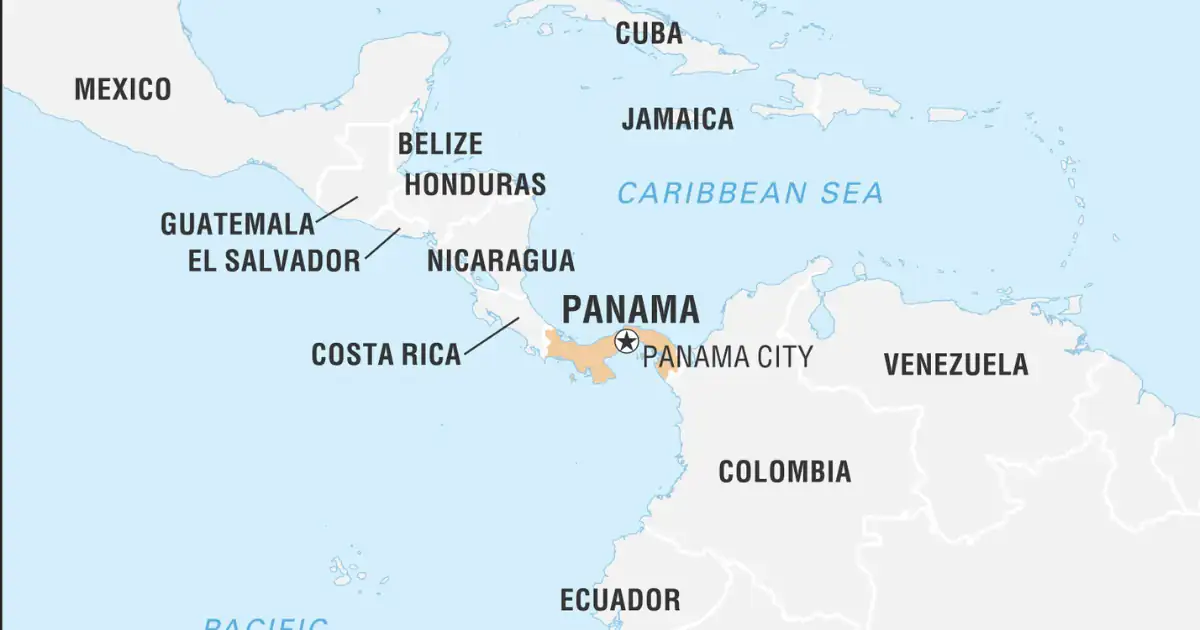
The strategic value both sides place on this partnership stems substantially from Panama's singular geography. Panama is a Central American country located on the Isthmus of Panama, the narrow strip of land connecting North and South America, and it is bordered by Costa Rica to the west and Colombia to the east, placing it at the literal hinge point between two continents.
"Panama is bounded by the Caribbean Sea to the north and by the Pacific Ocean to the south, with Panama City serving as its capital."
This dual-ocean positioning is precisely what has made Panama historically indispensable to global shipping, and it explains why India's maritime ministry views the country as a natural partner for logistics and connectivity cooperation into the wider Americas.
Physical Geography Shaping the Panama Canal's Operation
Panama's terrain is intimately tied to the infrastructure that gives it global significance. The country experiences a moist tropical and subtropical climate, and its landscape includes Lake Gatun, an artificial lake that plays a vital role in the operation of the Panama Canal, supplying the water needed to raise and lower ships through the canal's lock system.
"The Tuira River is the longest river in Panama, while the Cordillera Central, or Central Mountain Range, runs down the middle of the country."
This mountain spine, combined with the canal that cuts across the isthmus, has made Panama a linchpin of global maritime trade for over a century, a legacy that underpins the country's current pitch to India as a logistics and shipping partner. Beneath this landscape, Panama also holds natural resource wealth in gold, copper, manganese, and iron, offering additional avenues for economic engagement beyond the maritime sector.
Significance and the Way Forward
The deepening of India-Panama maritime ties carries clear strategic logic for India's broader engagement with Latin America and the Caribbean. As India's maritime sector undergoes what its ministry describes as a transformational expansion in infrastructure, digital innovation, and green shipping, a formal logistics and port-development partnership with Panama, sitting astride one of the world's most important shipping chokepoints, could meaningfully extend India's commercial reach across the Americas without requiring costly standalone infrastructure investment in the region.
The way forward will depend on how quickly the proposed bilateral agreement on maritime transportation and port development materialises, and whether the institutional linkages discussed, particularly between India's Directorate General of Shipping and the Panama Maritime Authority, translate into concrete technical cooperation. Panama's participation in India Maritime Week 2026 is likely to serve as an early test of how substantively both governments intend to operationalise the five pillars identified in these talks: logistics, shipping, maritime security, skilling, and digital transformation.
Conclusion
The recent India-Panama bilateral talks mark a deliberate effort to convert a centuries-old maritime relationship into a modern strategic partnership anchored in logistics, security, and digital cooperation. Given Panama's unique position astride the isthmus connecting two oceans and two continents, this partnership offers India a meaningful foothold for expanding its maritime and commercial footprint across Latin America and the Caribbean.