Nalabana Wildlife Sanctuary: Odisha’s Ramsar Wetland Hub for Migratory Birds
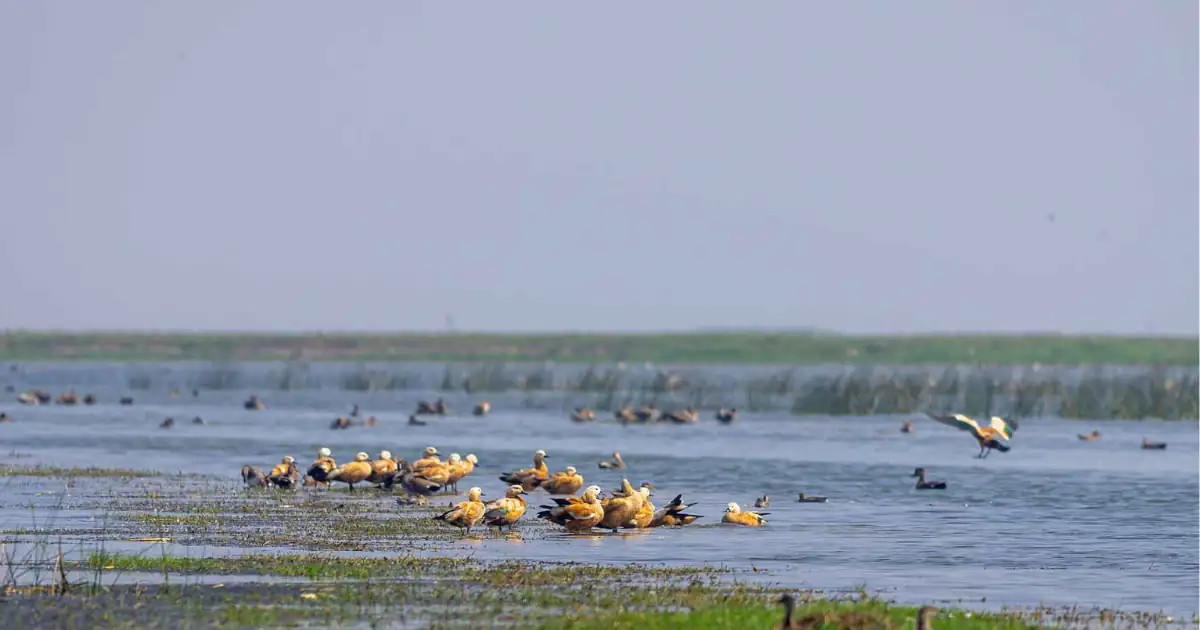
Recently, 24 fishermen were arrested for illegally fishing inside the Nalabana Wildlife Sanctuary, drawing attention to the ecological importance of this protected wetland and its role in conserving migratory birds.
24 Fishermen Arrested in Nalabana: Protecting Chilika's Bird Sanctuary Core
Altogether 24 fishermen were arrested by wildlife officials on Friday for illegally fishing inside the Nalabana Wildlife Sanctuary, after a patrol team detected them operating within the sanctuary's prohibited zone in Khordha district. Three mechanised boats, engines, bamboo oars, around 23 kilograms of fish, and nets were seized from their possession, Chilika Wildlife Division DFO Amlan Nayak said.
"During the investigation, forest officers found that the accused fishermen had trespassed into the sanctuary area, knowing that they were violating the Wildlife (Protection) Act 1972 by entering the prohibited zone."
Rasmita Jena, range officer of the Balugaon Wildlife Range, said that during a patrol in the Nalabana sanctuary area on Thursday afternoon, a team of wildlife officers detected at least three mechanised boats inside the prohibited zone and immediately seized them, and that the fishermen could not produce any authorisation or document permitting entry into the sanctuary. The accused, residents of Balipatapur and Chandrapur villages in the locality, now face three separate cases registered under the Wildlife Protection Act, with further inquiry ongoing. Officials warned that illegal fishing inside the sanctuary damages bird habitat and undermines the broader eco-fragility of the lake, an assessment that reflects the sanctuary's outsized ecological importance relative to its modest size.
Nalabana Wildlife Sanctuary: The Heart of Chilika's Bird Life
The site at the centre of this enforcement action holds particular ecological significance within one of India's most celebrated wetland systems. Nalabana Wildlife Sanctuary, also known as the Nalbana Bird Sanctuary, forms the core area of the Ramsar-designated wetlands of Chilika Lake in Odisha, occupying a major island at the centre of the lake spanning 15.53 square kilometres.
"The Island of Nalabana was declared a bird sanctuary in 1987 after observing the sheer number of diverse bird species found there."
This modest island supports a congregation of roughly 60 percent of the total migratory birds visiting Chilika Lagoon each year, an extraordinary concentration for such a compact protected area. Among the rare and threatened species recorded here are the Asian dowitcher, the critically endangered spoon-billed sandpiper, and Pallas's fish eagle, each drawing conservation attention disproportionate to the sanctuary's size. A distinctive seasonal feature of Nalabana is its complete submergence during the monsoon, when only a few treetops and a watchtower remain visible above the waterline, before the island re-emerges to host its winter congregations of migratory birds.
Chilika Lake: Asia's Largest Brackish Water Lagoon
Nalabana's ecological richness is inseparable from the larger lake system that surrounds it. Chilika Lake is a brackish water lake and shallow lagoon with estuarine character, located in Odisha, and it holds the distinction of being Asia's largest brackish water lake and the second-largest brackish water lagoon in the world, after the New Caledonian barrier reef in New Caledonia.
"Chilika is connected to the Bay of Bengal by a 32-kilometre-long and 1.5-kilometre-wide channel that runs mostly parallel to the bay, separated by a narrow spit."
The lake's hydrology is shaped by a seasonal interplay of fresh and saline water: the Daya and Bhargavi rivers feed it for most of the year, except during the dry months from December to June, when saline ocean water enters through a small passage instead. In 1981, Chilika became the first Indian wetland designated of international importance under the Ramsar Convention, a recognition that anchors much of the conservation attention the lake, and by extension Nalabana, now receives. The lake hosts some of the largest congregations of migratory birds in the country during winter, with flocks arriving from as far afield as the Caspian Sea, Lake Baikal, the Aral Sea, remote parts of Russia, the Kirghiz steppes of Mongolia, Central and Southeast Asia, Ladakh, and the Himalayas.
Significance and the Way Forward
The arrest of 24 fishermen underscores the persistent enforcement challenge facing one of India's most ecologically significant Ramsar sites, where the same waters that sustain migratory bird populations also support the livelihoods of local fishing communities, creating recurring tension between conservation mandates and economic subsistence. This is not an isolated episode: similar crackdowns on illegal fishing and poaching have periodically been reported within the Nalabana sanctuary and other Odisha wildlife areas such as Gahirmatha, suggesting an ongoing enforcement effort rather than a one-off action.
Sustaining Nalabana's role as a haven for nearly two-thirds of Chilika's migratory bird population will require continued vigilance from the Chilika Wildlife Division, but enforcement alone is unlikely to resolve the underlying pressure from local fishing communities dependent on the lake. A durable way forward likely involves pairing strict protection of the sanctuary's prohibited zone with livelihood support and alternative fishing zone arrangements for nearby villages, so that conservation of this globally significant wetland does not come at the cost of the communities that live alongside it.
Conclusion
The arrest of 24 fishermen inside Nalabana Wildlife Sanctuary highlights the delicate balance authorities must maintain between protecting one of Asia's most important bird habitats and managing the needs of local communities who depend on Chilika's waters. As the core sanctuary sustaining the majority of the lagoon's migratory bird congregation, including several rare and threatened species, Nalabana's continued protection remains central to preserving Chilika's standing as a globally significant Ramsar wetland.