Atmanirbhar Panchayat Programme & SAMARTH Portal Launched to Strengthen Panchayat Own Source Revenue
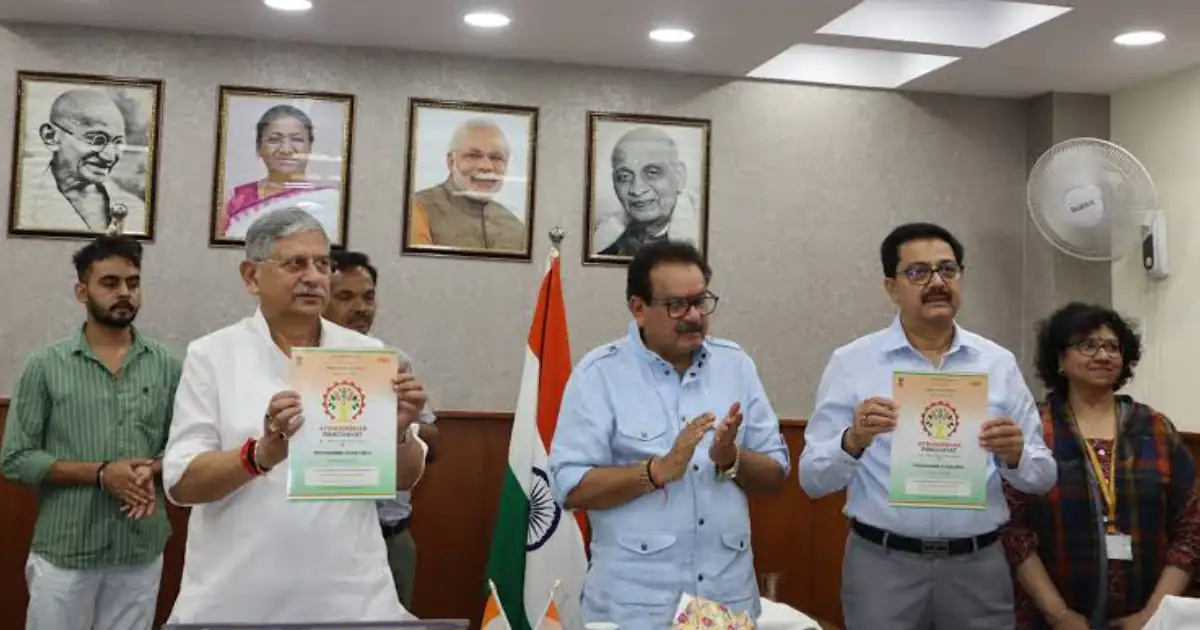
Recently, the Union Minister of Panchayati Raj launched the Atmanirbhar Panchayat Programme and the SAMARTH Panchayat Portal to strengthen the financial self-reliance of Panchayati Raj Institutions (PRIs) and enhance local governance through digital technology.
Atmanirbhar Panchayat Programme and SAMARTH Portal: Building Financial Self-Reliance at the Grassroots
Union Minister of Panchayati Raj Rajiv Ranjan Singh launched the Atmanirbhar Panchayat Programme and the SAMARTH Panchayat Portal at a function held at Krishi Bhawan in New Delhi, marking a significant step toward strengthening the financial and technological capacity of India's local self-government institutions.
"Financially empowered and technologically enabled Panchayats are central to achieving the vision of Viksit Bharat @2047."
Addressing the launch event, Singh said the newly introduced initiatives would help Panchayats become self-reliant by strengthening their own source revenues and improving grassroots governance through technology-driven solutions. The launch follows months of ministry-led outreach efforts across states including Telangana, Gujarat, and others, through which officials introduced Panchayat representatives to the vision, objectives, and operational framework of the programme ahead of its formal national rollout, with senior officials from NABARD and HUDCO participating throughout to underline their institutional backing.
Atmanirbhar Panchayat Programme: Turning Local Assets into Revenue
The Atmanirbhar Panchayat Programme is a unique initiative of the Ministry of Panchayati Raj, managed under the Rashtriya Gram Swaraj Abhiyan, designed to foster genuine financial independence among local governments. It enables Gram Panchayats and Block Panchayats to identify local assets and opportunities and, with dedicated technical support from the Ministry, develop them into bankable, revenue-generating projects that build a sustainable Own Source of Revenue, commonly referred to as OSR.
"The programme aims to bring transparency, efficiency, and self-reliance to local governance by digitising and monitoring tax and non-tax revenues collected by Panchayats."
Financing for these projects is structured to be genuinely multi-pronged, drawing on Public Private Partnerships, Corporate Social Responsibility contributions, convergence with other government schemes, and bank finance, with NABARD and HUDCO serving as key institutional partners providing both funding access and technical guidance. The programme's scale-up is deliberately phased: a total of 350 projects are targeted for development over four years, comprising 50 projects in the first year and 100 projects in each of the three years that follow. Eligibility is calibrated to ensure participating bodies have a credible revenue base to build upon, with Gram Panchayats required to have a minimum OSR of Rs 50 lakh and Block Panchayats a minimum OSR of Rs 1 crore, each with at least three years of tenure remaining, though these thresholds are relaxed for special category States to ensure equitable participation.
SAMARTH Portal: Digitising the Own Source Revenue Lifecycle
Complementing this project-based initiative is the SAMARTH Portal, a first-of-its-kind digital platform of the Ministry of Panchayati Raj built to strengthen the financial capacity of Gram Panchayats through technology-enabled OSR management. It has been developed as a unified, configurable national platform that allows Gram Panchayats to digitally manage the complete OSR lifecycle, spanning taxpayer registration, demand generation, online payments, collection, and real-time monitoring, replacing what has traditionally been a fragmented and often manual revenue administration process at the village level.
"The portal digitises the entire OSR system, enabling Panchayats to collect payments online while maintaining centralised records of panchayat-owned assets for revenue monitoring."
The platform has already been piloted successfully in Chhattisgarh and Himachal Pradesh, with Himachal Pradesh notably making SAMARTH mandatory across all 3,616 of its Gram Panchayats from 1 April 2026, and the government has outlined plans to extend the portal's rollout to Assam, Uttar Pradesh, and Maharashtra as the initiative scales nationally. By early May 2026, the portal's dashboard had already recorded submissions from over 15,000 Gram Panchayats along with several million registered taxpayers, indicating substantial early uptake even ahead of the formal national launch.
Significance and the Way Forward
Together, these twin initiatives address a longstanding structural weakness in India's decentralised governance architecture: the chronic under-utilisation of Panchayats' own revenue-generating potential and their continued dependence on devolved grants from higher tiers of government. By pairing a project-development mechanism, the Atmanirbhar Panchayat Programme, with a digital revenue-management backbone, the SAMARTH Portal, the Ministry is attempting to build both the asset base and the administrative infrastructure needed for genuine fiscal self-reliance at the grassroots, a goal closely tied to the broader vision of cooperative and competitive federalism underpinning Viksit Bharat @2047.
The way forward will depend heavily on execution at scale. Successfully identifying 350 genuinely bankable local projects across diverse Panchayat contexts, while ensuring smaller and financially weaker Panchayats are not left behind despite relaxed thresholds for special category States, will be a significant administrative challenge. Equally, the pace and quality of SAMARTH's rollout beyond its initial pilot states, particularly ensuring adequate digital literacy and infrastructure support at the Gram Panchayat level, will determine whether the platform delivers the transparency and efficiency gains it promises or remains underutilised in less digitally prepared regions.
Conclusion
The launch of the Atmanirbhar Panchayat Programme and the SAMARTH Portal marks a concerted push to make India's Panchayati Raj institutions financially self-sustaining rather than perpetually grant-dependent, combining a structured project-financing mechanism with a modern digital revenue backbone. As these initiatives scale from their pilot states to a nationwide rollout, their success will offer an important test of how effectively technology and institutional partnership can be harnessed to deepen genuine fiscal federalism at India's grassroots.