Kalpasar Project: Gujarat’s Mega Gulf of Khambhat Freshwater Reservoir Nears DPR Finalisation
Recently, the Detailed Project Report (DPR) for Gujarat's ambitious Kalpasar (Gulf of Khambhat Development) Project reached an advanced stage of finalisation, marking progress toward one of India's largest proposed multipurpose water infrastructure projects.
Kalpasar Project: Gujarat's DPR Nears Finalisation for a Sea-Spanning Freshwater Reservoir
The Detailed Project Report for Gujarat's ambitious Gulf of Khambhat, or Kalpasar, Project is at an advanced stage of finalisation, the Centre informed the Rajya Sabha recently.
"Ongoing Indo-Dutch technical cooperation is expected to strengthen the report through global best practices in coastal engineering, hydraulic modelling, salinity management, climate resilience, and water management."
The government further stated that the DPR incorporates appropriate engineering measures, hydraulic studies, and salinity management strategies to address the persistent challenge of salinity ingress in the project area. This parliamentary update builds on a significant diplomatic push earlier in the year: in May 2026, India and the Netherlands signed a Letter of Intent for technical cooperation on the project during Prime Minister Narendra Modi's visit to the Netherlands, formalising a partnership that draws on the Netherlands' globally recognised expertise in coastal water management, most notably embodied in its historic Afsluitdijk Dam. The DPR itself is being prepared by the National Centre for Coastal Research in Chennai, and once finalised, it will move to the project's Expert Advisory Group before proceeding to state and Union government approvals.
Kalpasar: Concept and Core Objectives
The Kalpasar Project, or the Gulf of Khambhat Development Project, is a proposed multipurpose water infrastructure initiative in Gujarat, designed to address the irrigation, drinking water, transport, and energy demands of the state's water-stressed Saurashtra region. The name itself, derived from "Kalp" and "Sarovar," evokes the idea of a reservoir capable of fulfilling future needs, an ambition reflected in the project's scale.
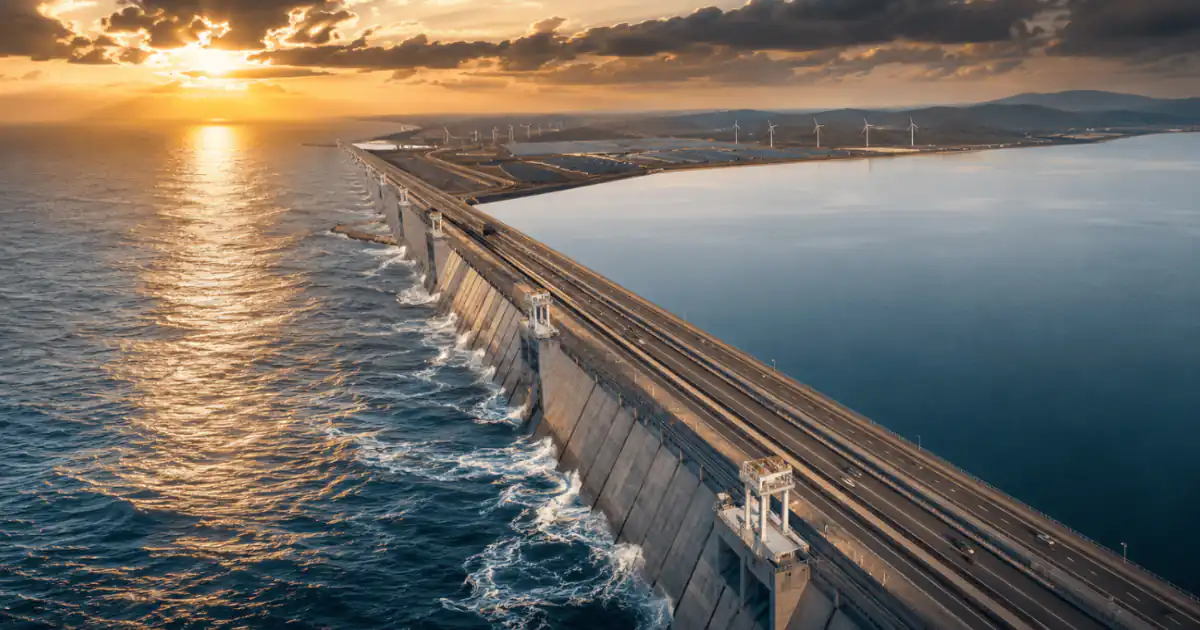
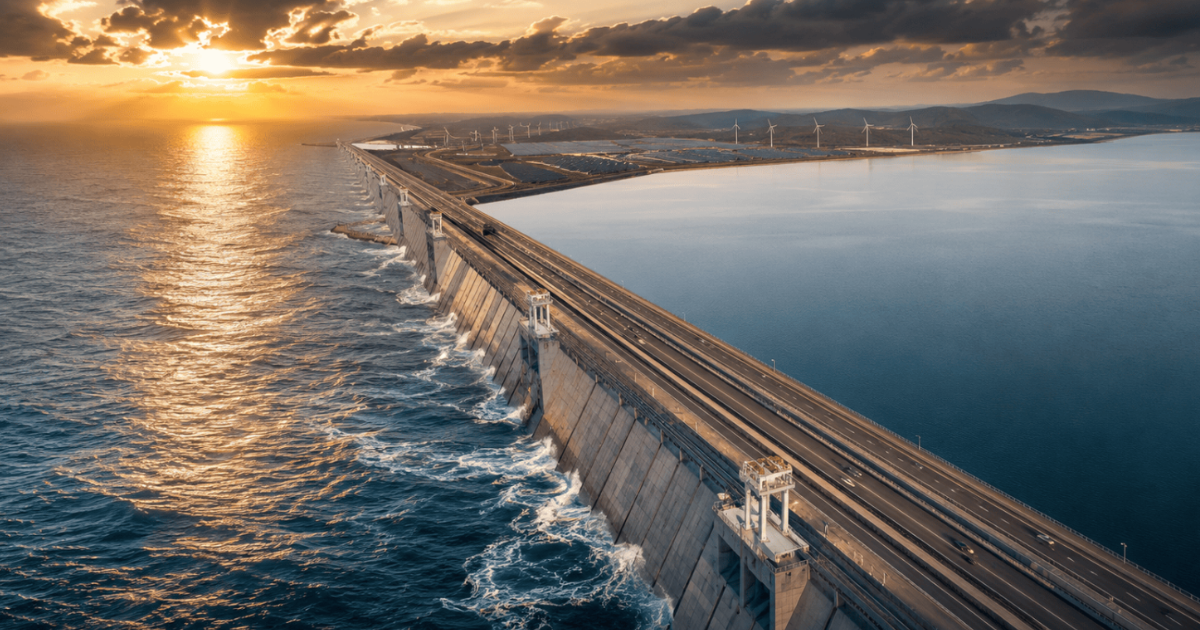
"The project proposes a long dam across the Gulf of Khambhat to create a reservoir spanning around 2,000 square kilometres, one of the world's largest coastal freshwater reservoirs."
The underlying engineering concept is straightforward in principle, if formidable in execution: rather than damming a river valley, the project would place a barrier across part of the Gulf of Khambhat to isolate an enclosed water body from seawater intrusion, allowing freshwater flowing in from surrounding rivers to progressively displace the trapped seawater and create a giant freshwater reservoir where a tidal gulf once stood.
Scale, Water Sources, and Irrigation Reach
The scale of the proposed reservoir is substantial by any global comparison. The project envisions a gross storage capacity of 13,000 million cubic metres, larger than the Sardar Sarovar Dam's capacity of 9,460 million cubic metres, positioning Kalpasar as potentially one of the largest freshwater storage structures in the world.
"The reservoir will receive water from four major rivers: the Sabarmati, Mahi, Dhadhar, and Narmada."
This freshwater inflow is expected to significantly enhance water availability across the perennially water-scarce Saurashtra region, with the project designed to irrigate nearly 10 lakh hectares spread across nine districts, a scale of agricultural transformation that underpins much of the project's stated economic rationale.
Beyond Water: Transport and Renewable Energy Components
Kalpasar's ambitions extend well beyond water storage alone. The project proposes a highway-cum-rail corridor built directly over the dam structure, a feature expected to dramatically reshape regional connectivity by reducing the travel distance between Bhavnagar and Surat by around 179 kilometres, bringing the journey down from approximately 356 kilometres to roughly 177 kilometres via the proposed dyke corridor.
"The project also envisages the development of around 2,470 MW of hybrid renewable energy capacity on reclaimed land that remains submerged during high tide."
This renewable energy component serves a dual purpose within the project's design, since the electricity generated is proposed to be used, among other purposes, for pumping freshwater to meet irrigation requirements in Saurashtra's coastal regions, effectively creating a self-sustaining energy-water loop within the larger infrastructure system. The Netherlands' role in providing technical expertise and engineering cooperation reflects the country's decades of accumulated experience managing exactly the kinds of challenges Kalpasar presents, including coastal flooding, salinity intrusion, and sea-level rise.
Significance and the Way Forward
Kalpasar's significance lies in its potential to simultaneously address four distinct developmental priorities for Gujarat, water security, irrigation expansion, transport connectivity, and renewable energy generation, within a single integrated infrastructure project, an ambition matched by few comparable undertakings globally. If realised at the scale currently envisioned, the project could transform Saurashtra's long-standing water scarcity challenges while reshaping regional transport geography through a dramatically shortened Bhavnagar-Surat corridor.
However, a project of this magnitude carries proportionate execution risk. The DPR's finalisation, while an important milestone, remains only a preparatory step; the project will still require environmental clearances, further engineering validation of salinity management and coastal ecosystem impacts, and eventual approval and financing from both state and Union governments before construction can begin. Given the scale of investment involved and the ecological sensitivity of a tidal gulf ecosystem, the way forward will likely involve careful, phased validation of the project's technical assumptions, particularly around salinity control and sediment management, before Kalpasar moves from a decades-long vision toward physical construction.
Conclusion
The advancing finalisation of Kalpasar's Detailed Project Report, backed by growing Indo-Dutch technical cooperation, marks a meaningful step forward for a project that has been discussed in various forms for decades. As Gujarat moves closer to converting this ambitious vision into an implementable plan, Kalpasar's ultimate success will hinge on translating its impressive engineering scale into a technically sound, environmentally sustainable reality for Saurashtra's water, transport, and energy future.