
Demographic Transition: Theory and Implications on India
Andhra Pradesh has recently announced financial incentives for families having a third and fourth child in response to emerging demographic challenges associated with declining fertility rates. The move reflects growing concern among several southern Indian states regarding population ageing and shrinking future workforce availability.
Demographic Transition Theory (DTT)
Andhra Pradesh recently announced financial incentives for families having a third and fourth child in response to changing demographic trends and declining fertility rates.
This reflects growing concern over population ageing and below-replacement fertility levels in several Indian states.
Replacement Fertility Rate
Meaning
Replacement fertility rate refers to:
The average number of children a woman must have
To replace herself and her partner in the population
Standard Replacement Level
Around 2.1 children per woman
This level ensures:
Stable population size over time
India’s Fertility Situation
National Level
India’s fertility rate is near replacement level
South Indian States
Several southern states have fertility rates around:
1.5 or lower
This is:
Below replacement level
“Low fertility today can lead to ageing societies tomorrow.”
About Demographic Transition Theory (DTT)
Definition
Demographic Transition Theory explains:
The shift from high birth and death rates
toLow birth and death rates
as societies develop economically and socially.
Origin of DTT
Warren S. Thompson (1929)
First proposed demographic transition concept
Frank W. Notestein (1945)
Further developed and popularized the theory
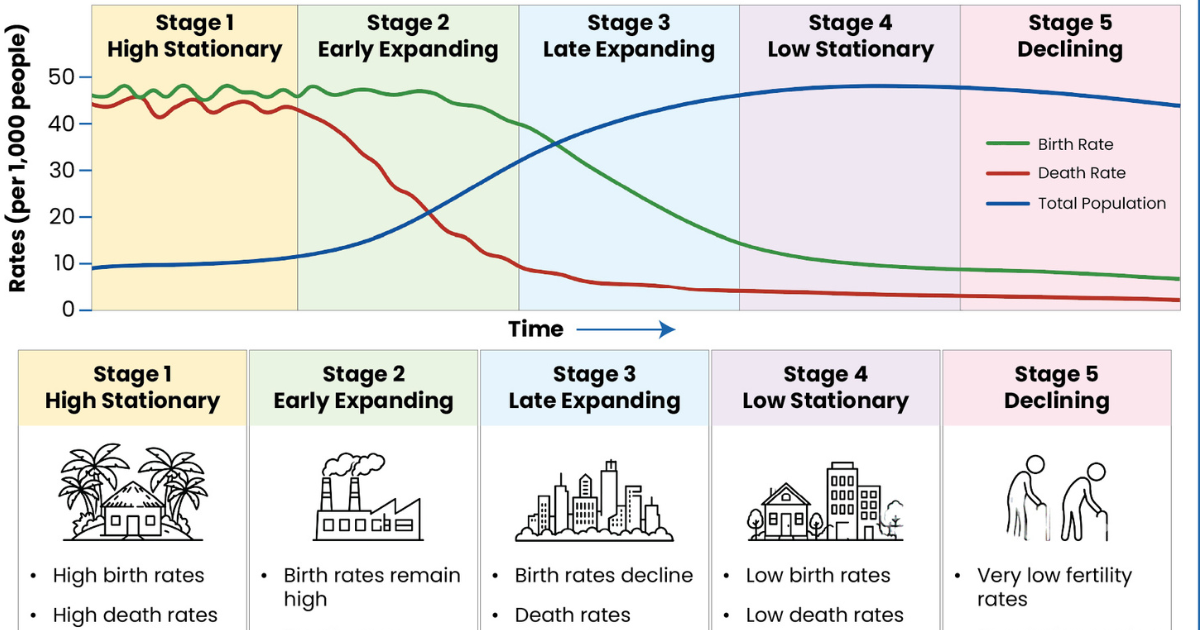
Stages of Demographic Transition
Stage 1: High Stationary Stage
Features
High birth rate
High death rate
Slow population growth
Causes
Poor healthcare
Disease
Low life expectancy
Stage 2: Early Expanding Stage
Features
Death rate declines rapidly
Birth rate remains high
Population grows rapidly
Causes
Better healthcare
Improved sanitation
Increased food availability
Stage 3: Late Expanding Stage
Features
Birth rate starts declining
Population growth slows
Causes
Urbanization
Education
Women empowerment
Family planning
Stage 4: Low Stationary Stage
Features
Low birth rate
Low death rate
Stable population
Common in
Developed economies
Stage 5 (Proposed Stage)
Features
Birth rate falls below replacement level
Population ageing and decline
Challenges
Labour shortages
Rising elderly population
Implications of Demographic Transition in India
1. Inter-State Demographic Divergence
Different states are at different stages of transition.
Younger States
States like:
Bihar
Uttar Pradesh
have:
Large young populations
Potential demographic dividend
Ageing States
Southern states face:
Declining fertility
Increasing elderly population
2. Changing Dependency Ratio
By 2050:
One in five Indians may be aged 60 or above
Projected elderly population:
Around 347 million
up from:
Approximately 149 million currently
3. Fiscal Challenges
Ageing populations may lead to:
Shrinking tax base
Higher pension expenditure
Increased healthcare costs
Greater fiscal stress
4. Labour Market Impact
Declining working-age population can cause:
Labour shortages
Reduced productivity growth
5. Political Implications
Delimitation Concerns
States with higher population growth may gain:
Greater parliamentary representation
This could alter:
Federal political balance
Importance of Demographic Dividend
Meaning
Demographic dividend refers to:
Economic growth potential resulting from a large working-age population
Conditions Required
To benefit from demographic dividend:
Quality education
Skill development
Employment opportunities
Healthcare access
Challenges Before India
1. Regional Imbalance
Uneven demographic patterns across states
2. Elderly Care Burden
Rising need for geriatric healthcare and social security
3. Job Creation
Need for productive employment for youth
4. Urban Pressure
Migration and rapid urbanization challenges
5. Social Security Gaps
Limited pension and welfare coverage
Measures Needed
1. Human Capital Development
Invest in education and skills
2. Women Empowerment
Improve workforce participation and healthcare access
3. Elderly Care Systems
Expand pensions and geriatric healthcare
4. Balanced Regional Development
Support high-fertility and low-fertility states differently
5. Employment-Centric Growth
Promote labour-intensive sectors
“Demography is not destiny unless supported by sound policy and human development.”
Significance for India
Demographic transition will shape:
Economic growth
Labour markets
Fiscal sustainability
Political representation
Social welfare systems
for decades ahead.
Conclusion
The recent policy measures by Andhra Pradesh reflect growing concern over declining fertility and ageing populations in parts of India. Demographic Transition Theory explains how economic and social development transforms population structures over time. For India, managing demographic transition effectively will require balancing demographic dividend opportunities with challenges related to ageing, employment, regional inequality, and fiscal sustainability.