
Countercyclical capital buffer
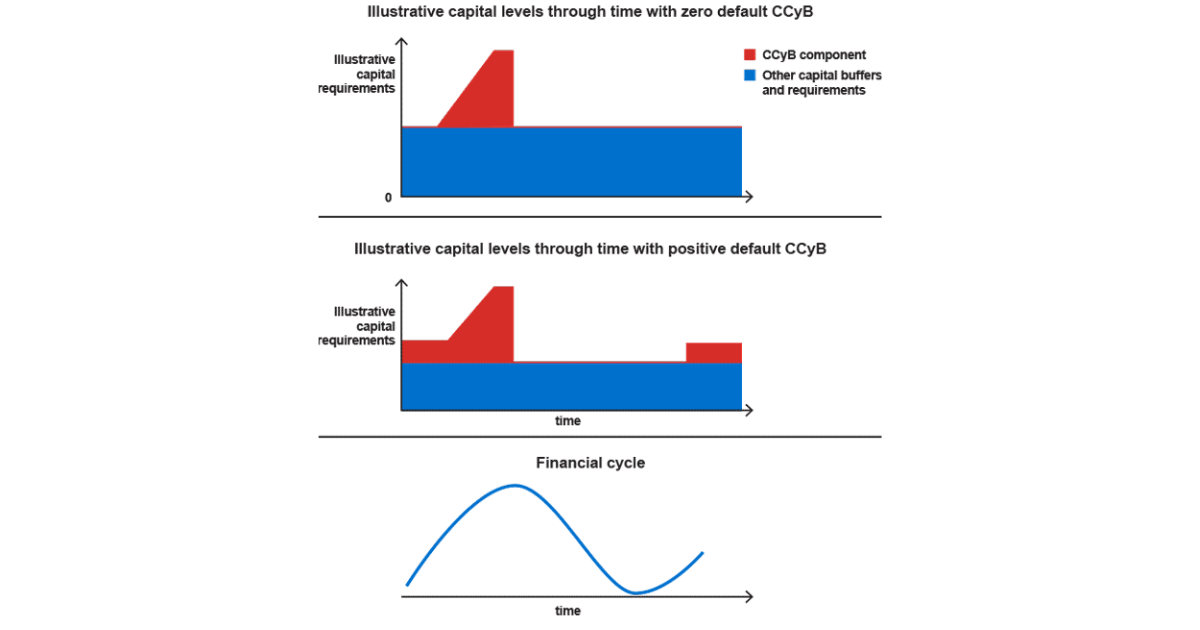
The decision by the Reserve Bank of India not to activate the Countercyclical Capital Buffer (CCyB) reflects its assessment that current credit conditions do not show signs of excessive systemic risk buildup.
Countercyclical Capital Buffer (CCyB)
The Reserve Bank of India has decided not to activate the Countercyclical Capital Buffer (CCyB), a key macroprudential tool under Basel III norms.
About Countercyclical Capital Buffer (CCyB)
The Countercyclical Capital Buffer is a Basel III regulatory requirement that mandates banks to build extra capital during periods of strong credit growth.
It is part of global banking reforms introduced after the 2008 global financial crisis.
Objective of CCyB
The CCyB aims to:
Prevent excessive credit expansion during economic booms
Reduce the risk of banking crises
Ensure banks remain stable during downturns
Strengthen the resilience of the financial system
How CCyB Works
During Economic Expansion (Boom Phase)
Credit growth is high
Asset prices may rise rapidly
Regulators require banks to build additional capital buffer
During Economic Downturn (Recession Phase)
Buffer can be released
Banks can use the capital to absorb losses
Supports continued lending to the economy
Capital Requirement
Under the Basel III framework:
CCyB ranges from 0% to 2.5% of Risk-Weighted Assets (RWA)
This is in addition to:
Capital Conservation Buffer (CCB)
Minimum capital requirements
Significance
1. Financial Stability
Reduces probability of banking crises
Prevents build-up of systemic risk
2. Smooth Credit Cycles
Avoids boom–bust lending cycles
3. Crisis Management Tool
Provides cushion during economic shocks
Why RBI May Not Activate CCyB
The decision of the Reserve Bank of India is typically based on:
Moderate credit growth
Stable banking sector indicators
Absence of systemic overheating
Controlled asset price inflation
Global Context
The CCyB is part of:
Basel Committee on Banking Supervision guidelines under Basel III reforms
Many countries activate CCyB only during credit booms and release it during crises (as seen during COVID-19 in several economies).
Conclusion
The Countercyclical Capital Buffer is a preventive financial stability tool designed to strengthen banks during credit booms and support the economy during downturns. The decision by the Reserve Bank of India to keep it inactive reflects a view that current credit conditions do not indicate systemic overheating.