
Zwan-Wolf Effect
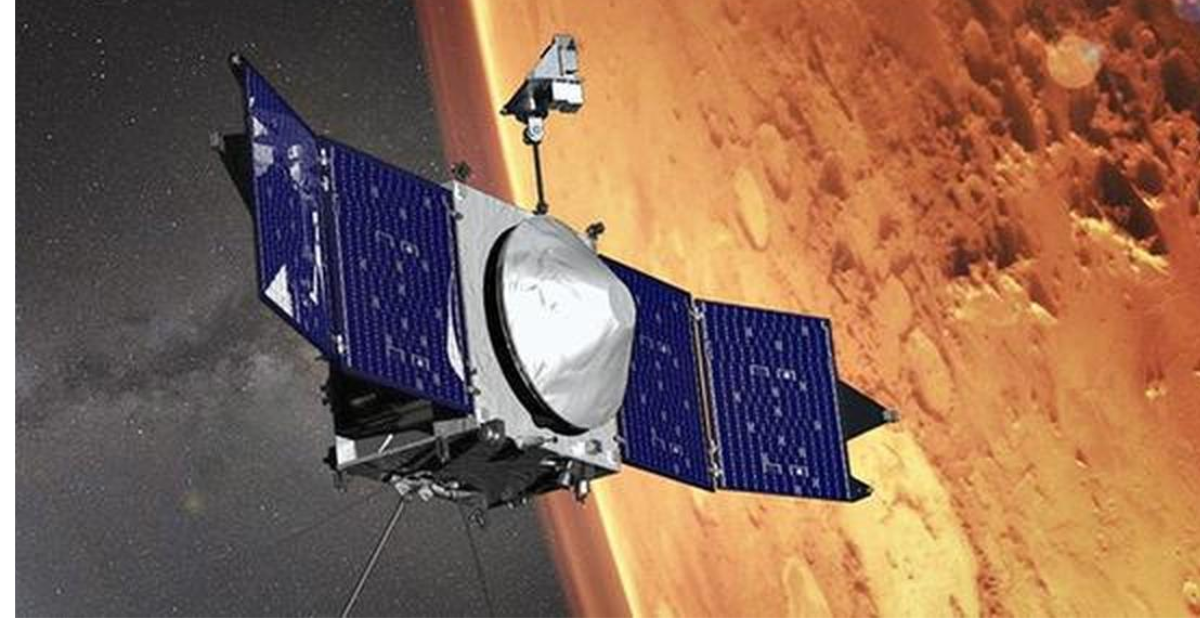
Scientists using data from MAVEN have, for the first time, observed the Zwan–Wolf effect operating in a planetary atmosphere, rather than only in a magnetosphere.
Zwan-Wolf Effect
Recently, scientists using data from:
MAVEN
made the:
“first-ever observation of the Zwan-Wolf effect occurring in a planetary atmosphere rather than only in a magnetosphere.”
About MAVEN Mission
MAVEN stands for:
Mars Atmosphere and Volatile Evolution
It is a:
Robotic orbiter mission of:
National Aeronautics and Space Administration (NASA)
Objective of MAVEN
The mission studies:
The upper atmosphere of:
Mars
including:
Atmospheric escape
Solar wind interaction
Climate evolution
What is a Magnetosphere?
A magnetosphere is:
“The region around a planet dominated by the planet’s magnetic field.”
It acts as:
A protective shield
against:Solar wind
Charged particles from the Sun
Example:
Earth has a strong magnetosphere.
About the Zwan-Wolf Effect
The Zwan-Wolf effect is:
“A phenomenon in which electrically charged particles are squeezed along magnetic structures called flux tubes.”
Simple Analogy
Scientists compare it to:
“Toothpaste being squeezed out of a tube.”
As particles move through narrowing magnetic pathways:
Their density increases
Their motion becomes concentrated
What are Flux Tubes?
Flux tubes are:
Tube-like regions formed by magnetic field lines
through which:Charged particles travel.
Importance of the Zwan-Wolf Effect
Deflecting Solar Wind
The effect helps:
Redirect or deflect solar wind around planets.
Solar wind consists of:
Streams of charged particles emitted by the Sun.
Importance of the Discovery
First Observation in a Planetary Atmosphere
Previously:
The effect was mainly observed in:
Magnetospheres
Now, scientists observed it directly in:
A planetary atmosphere.
This expands understanding of:
Planet–solar wind interactions.
Significance for Mars
Mars:
Has only weak localized magnetic fields
Lacks a strong global magnetosphere like Earth.
Studying this effect helps scientists understand:
Atmospheric loss on Mars
Evolution of the Martian climate
How solar wind strips away gases
Broader Scientific Importance
Space Weather Understanding
Improves knowledge of:
Solar wind behaviour
Planetary protection mechanisms
Planetary Evolution
Helps explain:
Why Mars lost much of its atmosphere over time.
Future Space Missions
Useful for:
Human Mars missions
Radiation protection studies
Atmospheric modelling
Conclusion
“The discovery of the Zwan-Wolf effect in a planetary atmosphere represents an important advancement in planetary science.”
Using data from MAVEN, scientists gained deeper insights into how magnetic structures interact with charged particles and solar wind, improving understanding of atmospheric evolution and space weather processes on planets like Mars.