When will Matsya-6000 make its first trial dive? Is the programme on track?
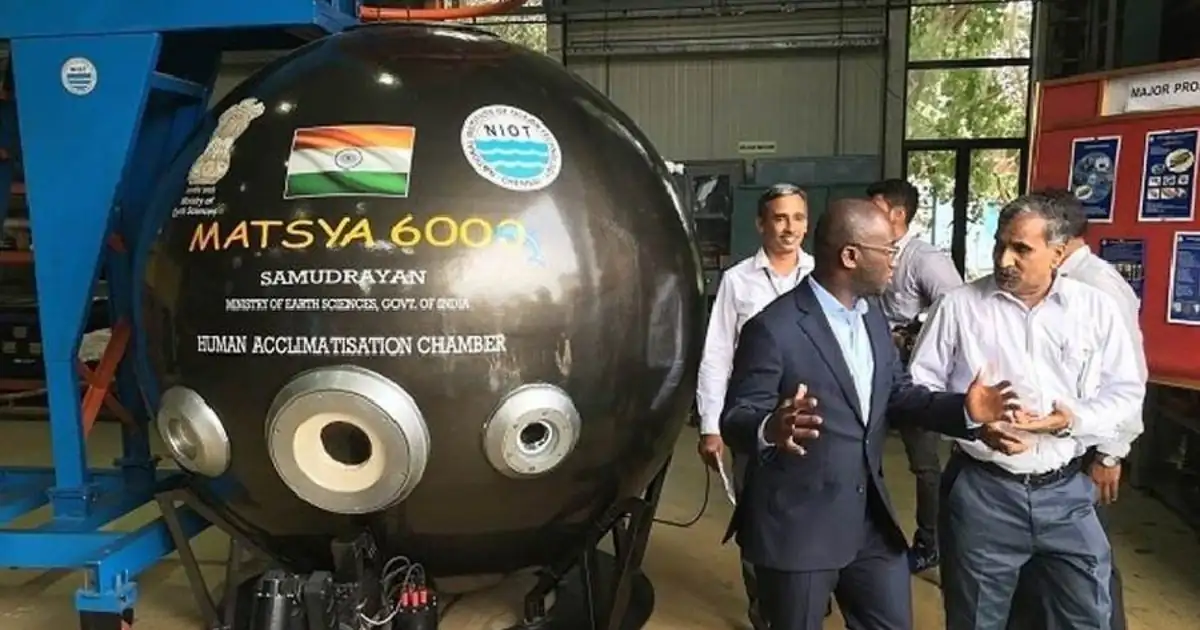
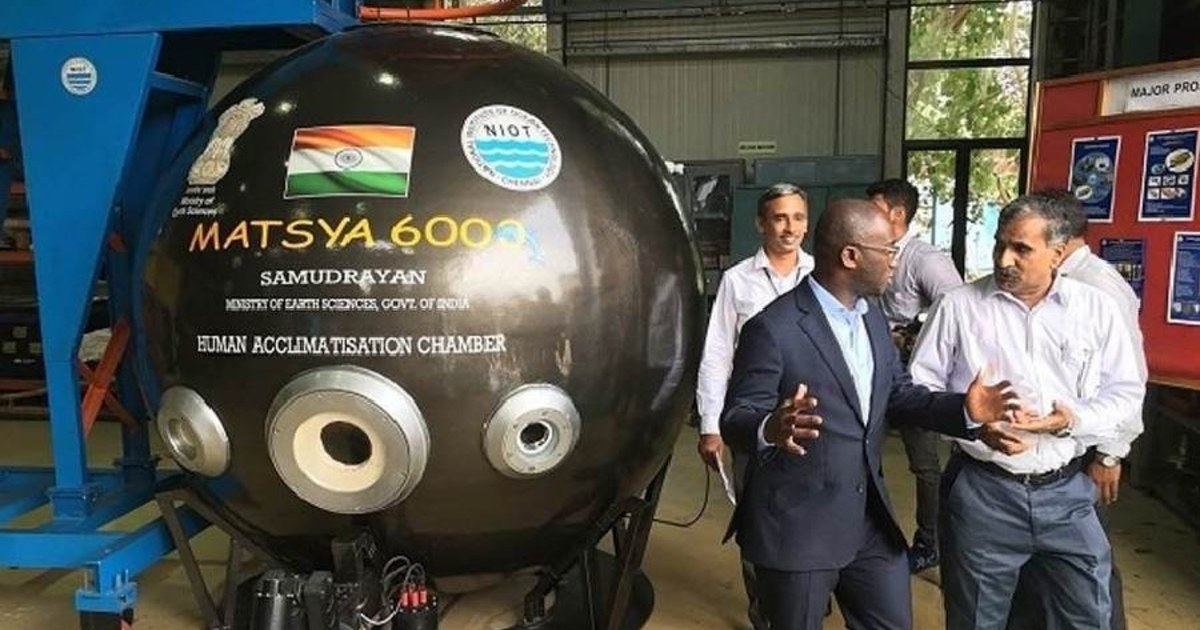
India's crewed submersible Matsya-6000 is set for a 500-metre trial dive in the Bay of Bengal in early 2027. We explain Samudrayaan, the titanium sphere, the Deep Ocean Mission, India's seabed claims and the slipping timeline. Read on!
1. When will Matsya-6000 make its first trial dive?
India's crewed deep-sea submersible, Matsya-6000, is set for its first trial dive in January-February 2027. The dive will go to 500 metres in the Bay of Bengal, said Srinivasa Kumar Tummala, Secretary, Ministry of Earth Sciences.
The vehicle is being built in phases, and the 500-metre trial is the first of them. Its full design depth is 6,000 metres. Two pilots from the National Institute of Ocean Technology (NIOT), called aquanauts, are already in training.
The date matters because the target has moved several times.
2. What are Samudrayaan and Matsya-6000?
Samudrayaan is India's crewed deep-sea project. Union Minister Jitendra Singh launched it at Chennai on 29 October 2021 as India's first manned ocean mission. Matsya-6000 is the vehicle the project is building.
The submersible is designed to carry three people in a 2.1-metre-diameter spherical hull down to 6,000 metres. NIOT, an autonomous institute under the Ministry of Earth Sciences (MoES), designs and develops it.
Its purpose is to observe the seabed and sample deep-sea minerals such as nickel, cobalt, rare earths and manganese, with spin-offs expected in underwater engineering.
Note: Three names are easy to mix up. The Deep Ocean Mission is the umbrella programme, Samudrayaan is the crewed project under it, and Matsya-6000 is the submersible itself.
3. How is the submersible built to survive the deep ocean?
The crew sits inside a personnel sphere made of a titanium alloy, Ti6Al4V ELI. The Indian Space Research Organisation (ISRO) worked with NIOT on this hull, which ISRO rates to 600 bar of external pressure.
Within ISRO, the Vikram Sarabhai Space Centre (VSSC) handled design and material development. The Liquid Propulsion Systems Centre (LPSC) did the electron beam welding, joining metal with a focused beam of electrons, on walls 80 mm thick.
The 7,100 mm weld took 32 minutes after nearly 700 trials, a first in the country by ISRO's account.
The Defence Research and Development Organisation (DRDO) handles navigation, positioning and the underwater acoustic telephone. Lithium-polymer batteries power propulsion. Safety features include a bio-vest that monitors crew health and a human-rated emergency ballast system.
Wet harbour trials, tests in sheltered water, were held in January-February 2025 at the L&T shipbuilding facility in Katupalli, Tamil Nadu.
4. Where does it sit in the Deep Ocean Mission?
The Union Cabinet approved the Deep Ocean Mission on 16 June 2021, with MoES as the nodal ministry. Its outlay was Rs 4,077 crore over five years, of which Phase 1 (2021-24) accounted for Rs 2,823.4 crore.
The mission has six components. The submersible belongs to the first, together with an integrated system to mine polymetallic nodules, seabed deposits holding nickel, copper and cobalt, at 6,000 metres in the central Indian Ocean.
The others cover ocean climate advisory services, deep-sea biodiversity, exploration for hydrothermal sulphides on mid-oceanic ridges, an ocean-energy desalination study and a marine biology station.
Deep Ocean Mission approved: 16 June 2021
Outlay: Rs 4,077 crore over five years
Nodal ministry: Ministry of Earth Sciences
Samudrayaan launched: 29 October 2021, Chennai
Endurance: 12 hours normal, 96 hours emergency
First trial dive: 500 m, January-February 2027, Bay of Bengal
ISA nodule contract: 25 March 2002, 75,000 sq km, Central Indian Ocean Basin
5. Why does India want to reach the deep seabed?
The interest goes back to 2002. On 25 March that year, India signed a 15-year exploration contract with the International Seabed Authority (ISA) for 75,000 sq km in the Central Indian Ocean Basin. The Cabinet approved a five-year extension on 12 September 2016.
India's ISA contract also covers 10,000 sq km for polymetallic sulphides across the Central Indian Ridge and the Southwest Indian Ridge. A crewed vehicle lets scientists observe and sample such sites directly.
India is not the first to try. At the 2021 launch, the government placed its effort alongside the USA, Russia, Japan, France and China, which already have such vehicles. China's Fendouzhe, from 2020, reached about 11,000 metres.
In August 2025, NIOT scientists joined dives aboard Nautile, the crewed submersible of France's IFREMER, reaching 5,000 metres in the Atlantic.
6. Is the programme on track?
In 2021, the plan was sea trials of a 500-metre shallow-water version in the last quarter of 2022, and Matsya-6000 ready for trials by the second quarter of 2024.
Parliamentary replies in December 2022 and February 2025 said the mission was expected to be realised by 2026. The first 500-metre dive is now planned for early 2027.
The case that it is progressing
The hardest parts are being done. The titanium sphere is welded, harbour trials are complete, pilots are in training and NIOT scientists have dived abroad. Starting at 500 metres limits risk to the crew.
The case for caution
Every deadline so far has slipped, and the dive now planned is still the shallow first phase. The mission was approved for five years from 2021, a window the 2027 trial falls outside.
What a 500-metre dive cannot prove
A successful dive will test the vehicle and crew at one-twelfth of the design depth. It will not test the sphere at full depth, nor bring nodule mining closer: that needs the separate mining system the mission lists alongside the submersible.