What is the Jan Aushadhi scheme? What will its 25,000-Kendra target really measure?
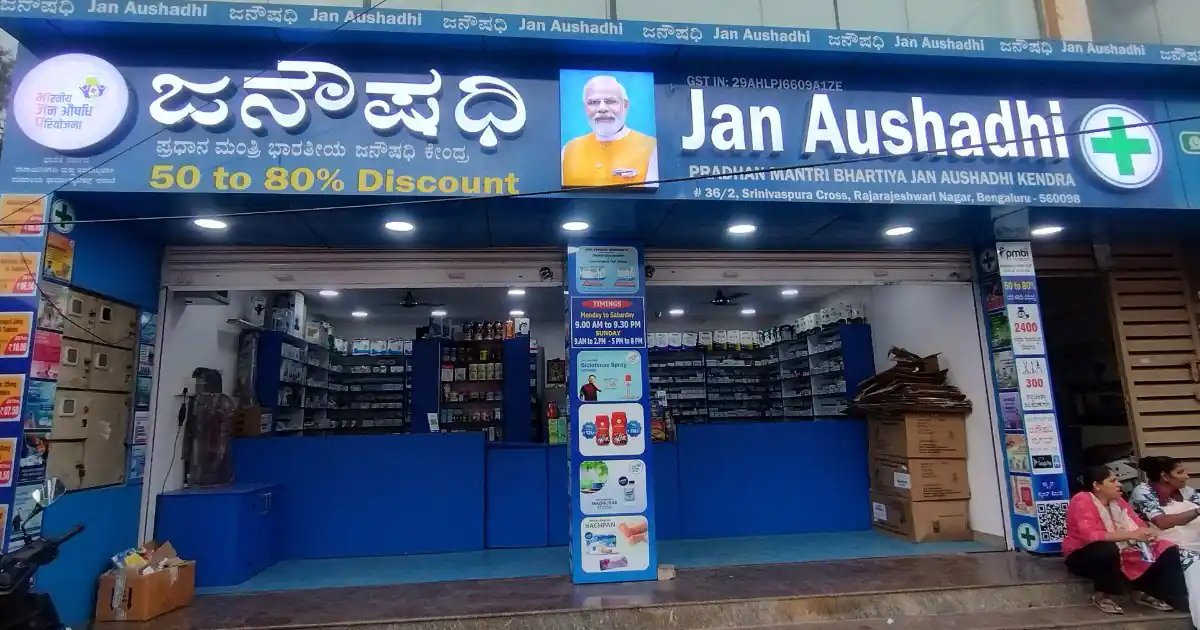
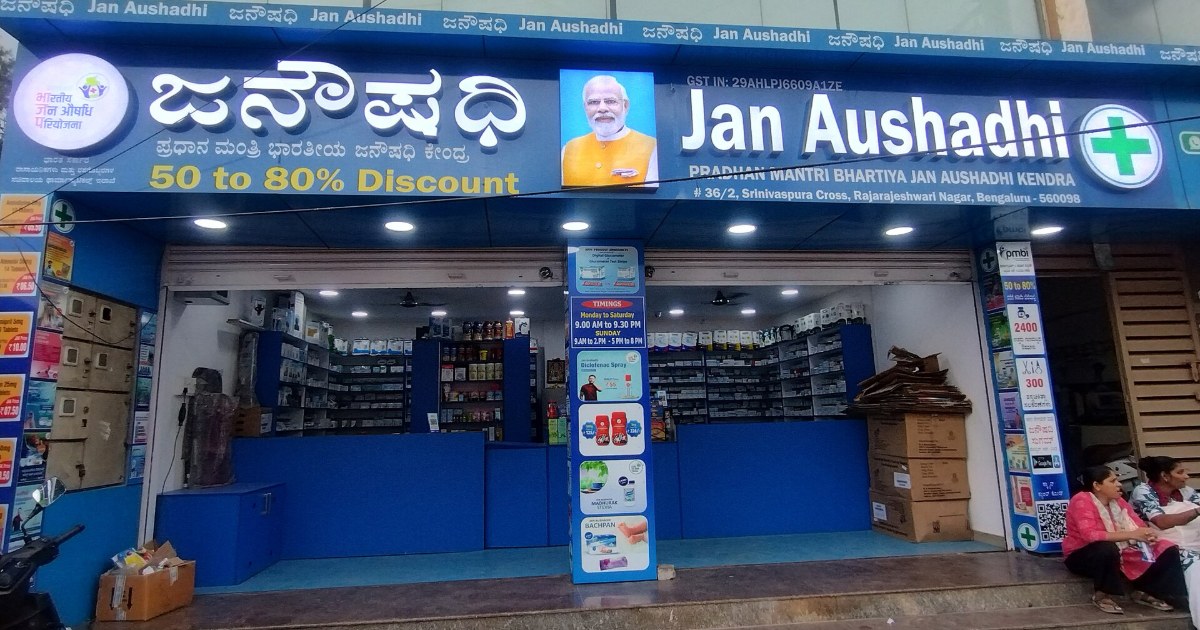
The Jan Aushadhi network grew to 20,547 Kendras by end July 2026, against a target of 25,000 by March 2027. Its outlets sell generic medicines, sold under the active ingredient's name rather than a brand, at prices generally 50% to 80% lower. Read on!
1. How far has the Jan Aushadhi Kendra network grown in 2026?
Low-cost generic medicines are now sold from over 20,000 dedicated outlets, and the Government wants about 4,450 more by March 2027.
The Pradhan Mantri Bhartiya Janaushadhi Pariyojana (PMBJP) had 20,547 Jan Aushadhi Kendras at the end of July 2026. That is up from 17,990 at the end of December 2025.
The Government's target is 25,000 Kendras by March 2027. On the end-July count, that means roughly 4,450 more outlets in about eight months.
Government estimates put citizens' savings at about Rs 9,000 crore in 2025-26, with sales at maximum retail price (MRP) of Rs 2,252 crore in the same year.
2. What is the Jan Aushadhi scheme?
It is a scheme of the Department of Pharmaceuticals in the Ministry of Chemicals and Fertilizers. Its aim is simple: sell quality generic medicines at low prices through dedicated outlets called Jan Aushadhi Kendras.
A generic medicine is sold under the name of its active ingredient rather than a brand name. The patient pays for the medicine, not the brand.
The scheme was launched in 2008 and revamped in 2015. Its implementing agency is the Pharmaceuticals and Medical Devices Bureau of India (PMBI).
3. What does a Kendra sell, and at what price?
The product basket has 2,110 medicines and 315 surgical items, spread across 29 therapeutic categories. The wider the basket on a Kendra's shelf, the more of a patient's prescription it can fill in one visit.
Prices are generally 50% to 80% lower than comparable branded medicines. The scheme also sells Suvidha sanitary napkins at Rs 1 a pad.
For a household paying for long-term medicines out of pocket, a gap of that size changes the monthly budget, which is the scheme's whole purpose.
4. How does a Kendra operator earn?
Kendras run on a franchise model: entrepreneurs open and run them under the scheme. The operator's income comes from a fixed trade margin and a capped incentive on purchases.
The scheme's mechanics, in short:
Ministry: Department of Pharmaceuticals, Ministry of Chemicals and Fertilizers
Implementing agency: Pharmaceuticals and Medical Devices Bureau of India (PMBI)
Launched / revamped: 2008 / 2015
Basket: 2,110 medicines and 315 surgical items, 29 therapeutic categories
Price against branded equivalents: generally 50% to 80% lower
Operator's trade margin: 20% of MRP, excluding taxes
Incentive: 20% of monthly purchases, capped at Rs 20,000 a month and Rs 5 lakh in total
One-time grant: Rs 2 lakh (Rs 1.5 lakh furniture, Rs 0.5 lakh computer)
Who gets the grant: women, Divyangjan and SC/ST entrepreneurs, and Kendras in aspirational, Himalayan, island and North-Eastern areas
Condition for incentives: stock at least 200 fast-moving medicines
Kendras: 17,990 (end Dec 2025) → 20,547 (end July 2026)
Target: 25,000 by March 2027
Note: The count of 20,547 Kendras is as at end July 2026. A Government explainer of March 2026 gave a figure of over 18,000; the two describe different dates, not a dispute.
The 200-medicine condition matters. A Kendra that stocks only a handful of products cannot replace a regular chemist for a patient, so the incentive is tied to range.
5. What are the two sides of expanding the network?
The case for more Kendras
Every new outlet brings the 50% to 80% price gap to one more neighbourhood. The one-time grant for women, Divyangjan and SC/ST entrepreneurs, and for remote regions, also uses the scheme to widen who gets to run a business.
The case for caution
The operator's support is front-loaded. The incentive stops at Rs 5 lakh in total, after which a Kendra must survive on its 20% margin on low-priced medicines. A fast-growing count can hide outlets that struggle once the incentive runs out.
What the count cannot show
Savings depend on patients actually buying the generic at the counter. A new outlet adds that option in a neighbourhood. The number of outlets measures supply, not how many prescriptions are being filled there.
6. What will the 25,000-Kendra target really measure?
The network added about 2,550 Kendras between December 2025 and July 2026. Reaching 25,000 by March 2027 means adding outlets faster than that. The scheme's grants for first-time operators and incentives tied to stocking are built for such expansion.
But the scheme's success is better judged by savings per household and by how much of its basket actually reaches patients. Sales of Rs 2,252 crore at MRP are a clearer signal of use than the number of shops.
The outlet count tells us where a Kendra exists. It does not tell us whether the medicine a patient needs is on the shelf, and that is the limit any target built on counting outlets cannot get past.